Sunday, February 26, 2023

Glade Windflower - Anemone berlandieri


Glade windflower (aka 10-petal thimbleweed) (Anemone berlandieri) is an early spring ephemeral native to Jackson and Washington Counties in the central Panhandle and five counties in the Big Bend region of western peninsular Florida.  In these areas, it is most common in well-drained sunny locations such as roadsides and open hammocks.  These photos were taken recently near Goethe State Forest in Levy County along a 2-lane highway.  This beautiful wildflower is also recorded in other states of the Southeast Coastal Plain from Texas, Oklahoma and Arkansas to Virginia on the East Coast, though it is quite rare from Georgia north.

Glade windflower dies back to the ground by summer after blooming and setting seed and it is one of the first wildflowers to emerge in spring.  It produces a few basal leaves near the ground which can be difficult to detect amongst the other vegetation.  Their shape is detailed in the photo above.  A single flower stalk arises from these basal leaves in late January to early February in Florida.  This stalk stands between 6 and 12 inches tall.  The common name "Ten-petal thimbleweed" is a misnomer as the 10 "petals" are actually sepals - the parts of a flower bud that typically cover the petals before the bloom opens. There are no true petals in the case of this wildflower.  The sepals can be anywhere from white (as they are in these photos) to a deep lavender.  The center of the flower (the female pistils) is thimble-shaped and contains a great many anthers as well.  From this structure, many wind-borne seeds are produced by late spring - hence the common name of "windflower".

Glade windflower is not currently propagated by any nursery affiliated with FANN - the Florida Association of Native Nurseries, and is only rarely offered by sources outside of Florida. This puzzles me as the species is not listed, produces large amounts of seed and appears to be easy to provide for.  Hopefully, someone here in Florida will pick it up and begin to offer it to the public.

Wednesday, November 16, 2022

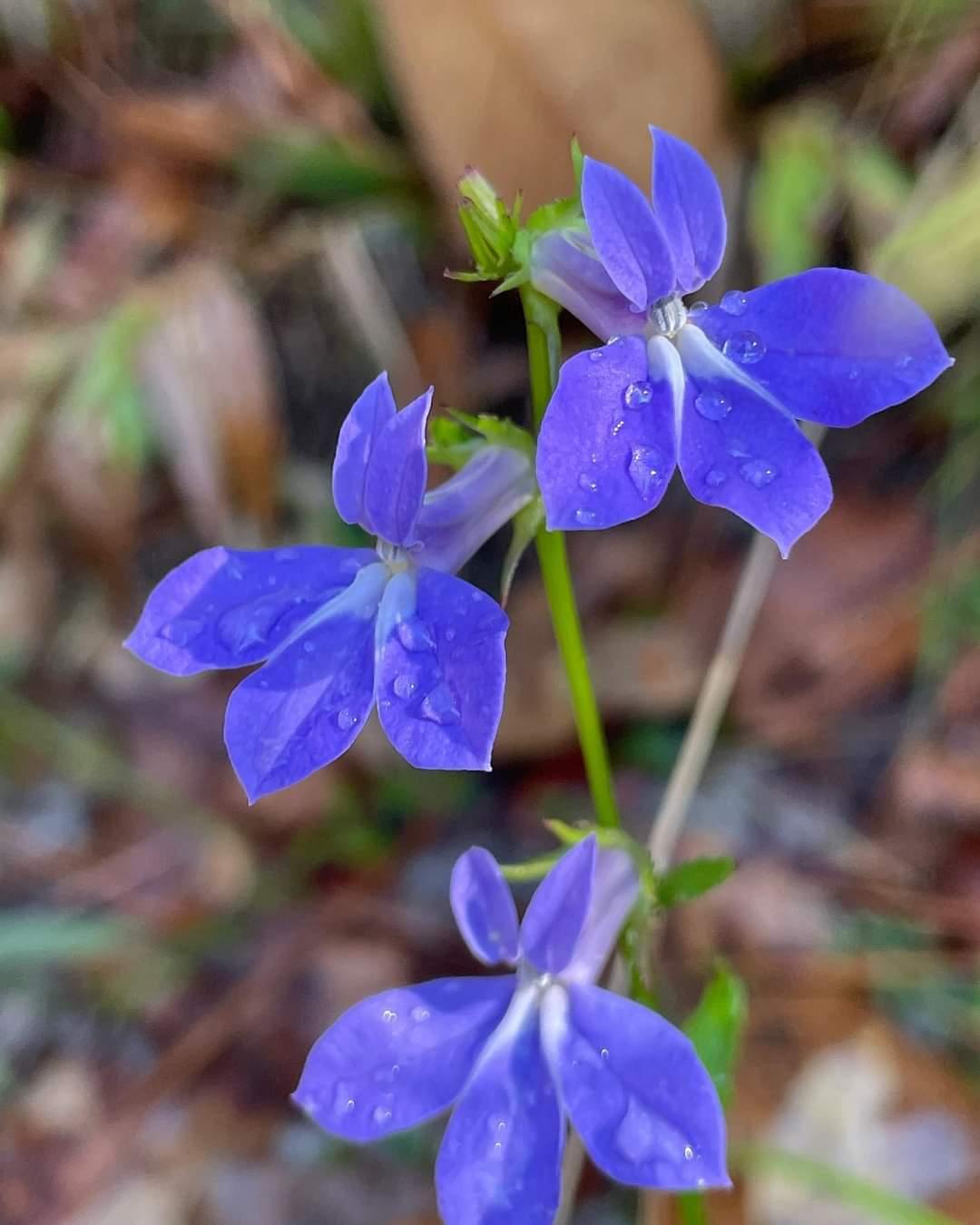
Southern lobelia - Lobelia georgiana


Flowers


Foliage in situ
Southern lobelia (Lobelia georgiana) seems to be a rather poorly described species based on the lack of unified descriptions of this species online.  While some sources list its natural range as occurring throughout much of the Southeastern Coastal Plain - Mississippi to Virginia, others list it as native only to 3 of these counties - Alabama, Georgia and Florida. in Florida, it has been vouchered from 10 central Panhandle counties with a disjunct population reported from Marion County. It seemingly has often been misidentified with other closely related species. In L. georgiana the lower lip of corolla is usually glabrous on upper surface near throat of corolla tube, but occasionally papillate or minutely pubescent (with very short hairs); calyx tube usually glabrous, rarely with a few scattered chaffy hairs, but often with a warty texture; corolla tube glabrous.  Regardless, throughout its range, it occurs most often in forested wetland habitats such as along riverine floodplains. 
This is a perennial wildflower that dies back to the ground in winter. Its basal leaves are similar to other members of this species. The simple flower stalks eventually reach 3-4 feet in height by late summer. The leaves are alternate on the stem and have entire margins or are shallowly toothed.  The deep blue to purple blooms are produced in fall. They are of greatest interest to bees for pollination.
I am not aware of this lobelia ever being offered for sale commercially. It would require conditions very similar to other wetland members of this genus.
The flower photo was taken by Lily Byrd and used with permission. The aspect photo at the bottom is credited to Mathew Mrizek and was posted to iNaturalist.

Sunday, November 13, 2022

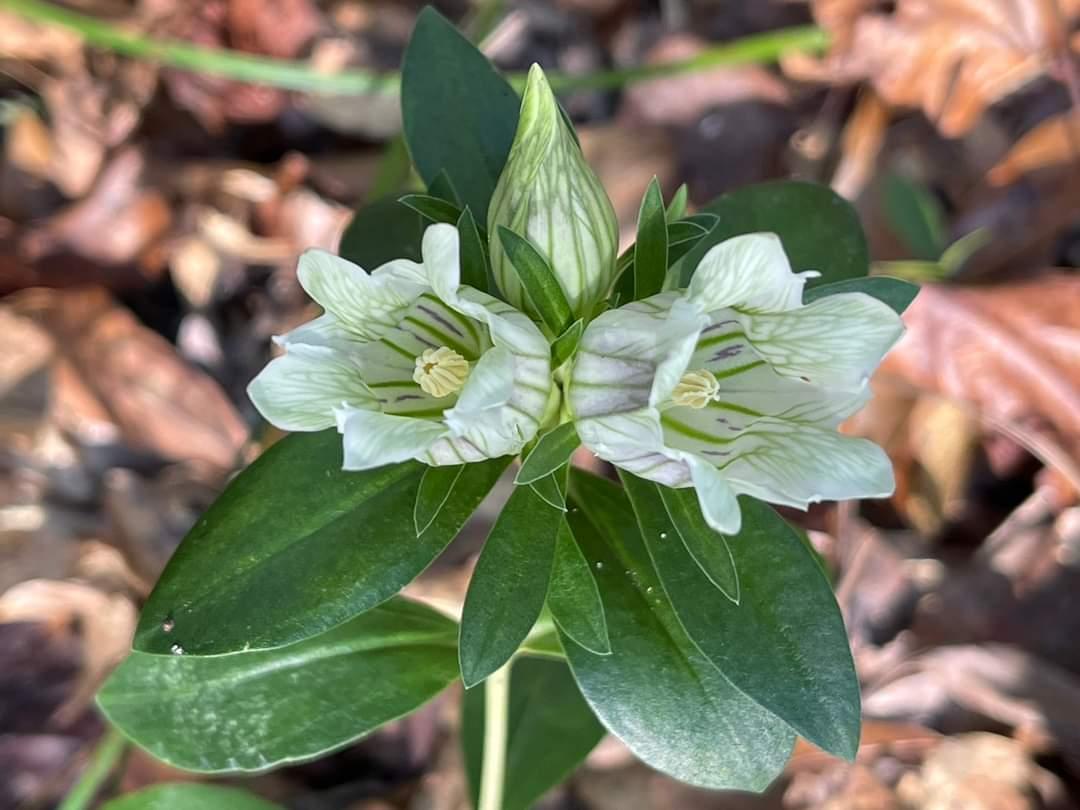
Striped gentian - Saponaria villosa


Striped gentian (Gentiana villosa) is Florida's most unique member of this beloved genus - having white to very pale blue striped flowers instead of the usual deep blue ones.  It is found in seven Panhandle counties in extreme north Florida, but is found in much of the Southeast Coastal Plain from Louisiana to Virginia and Maryland.  Throughout its range, it is most often encountered in open woodlands.

Although its Latin species name means "hairy", the foliage is decidedly glabrous.  The leaves are lanceolate but are typically wider above the middle of the leaf. The leaves are dark green and shiny. like other members of this genus, it is a perennial that dies back to the ground each winter and emerges again in early spring.  Mature plants can reach 2 feet in height.  The flowers buds are clustered at the top of the plant. Striped gentian typically blooms during the fall in late August to October. The flowers are pollinated mostly by bees that are attracted to their stripes and nectar. The seed capsules ripen during October to November. The seeds of G. villosa differ from other gentians because they are wingless.

Gentians have long been used medicinally by herbalists.  As one of its common names suggest  (Sampson's snakeroot), striped gentian is thought to aid in the relief of snakebites. In Appalachia, its roots are carried as a charm. The Catawba Indians used the boiled roots as medicine to relieve back pain. 

Despite the charm and utility of gentians, few are ever offered commercially and none are available from nurseries affiliated with FANN - the Florida Association of Native Nurseries.  This is regrettable and so this species and its relatives must solely be admired when encountered in the fall when hiking in  their preferred habitat.  Do not be tempted to collect it.

These photos were taken by Helen Roth and used by permission. 

Sunday, November 6, 2022

Grassleaf blazing star - Liatris elegantula


Grassleaf (Shaggy) blazing star (Liatris elegantula) is an upland member of this decidedly abundant Florida genus, common to sandhill and xeric oak uplands in most of the north Florida counties and south along the Gulf Coast to Citrus County.  It also has been vouchered from nearly all of Georgia and Alabama and is reported from a few counties in extreme eastern Mississippi.  This, like nearly every member of this genus, is a perennial herbaceous species that dies back to the ground in late fall and reemerges again in spring. It is reported to prefer moist, but well-drained soils.

The leaves are simple and nearly linear, alternate along the stem and are without the "hairs" found in many other species such as L. savannensis and L. gracilis.  The simple flowering stalk reaches its mature height of about 3 feet by August and the blooms open from the top of the stalk downwards for the next 2-3 weeks.  The flower buds are sessile (without a stalk) and are slightly hairy.  Like most members of this genus, the flowers are lavender and attract the attention of a great diversity of pollinators.  

Florida is home to 19 species of blazing stars, but only a few are grown commercially by native plant nurseries affiliated with FANN - the Florida Association of Native Nurseries. Grassleaf blazing star is one of the many that I have not seen offered.  Blazing stars are easy to propagate from mature seed collected in late fall and sown immediately just below the soil surface in flats.  As all blazing stars are beautiful additions to a pollinator garden, more species, like this one, should be made available in the future.

These photos were taken by my friend, Lily Byrd, and shared by permission.

Sunday, October 30, 2022

Calico aster - Symphyotrichum laterifolium


Calico aster (Symphyotrichum laterifolium) is a common aster native to much of north Florida and the Panhandle in partly sunny locations within deciduous woodlands and roadsides.  It also has been vouchered in every state east of the Mississippi River as well as a line from east Texas to the Dakotas and all of the Canadian provinces from the Atlantic to Manitoba.  Throughout this extensive range, it occurs in sandy to moist habitats, often in partial sun.  

Like most true asters in this genus, calico aster is a perennial wildflower that dies back in the winter and reemerges in the spring.  It produces a basal cluster of ovate leaves with dentate margins.  Multiple stems emerge and reach a mature height of 3-4 feet in the early fall.  The stem leaves are elliptical and numerous. The mostly hairless leaves have a characteristic hairy midrib on their back faces, and branching is usually horizontal or in what can appear to be a zigzag pattern. 

Flowering occurs in late summer to mid-fall.  The flowers of calico aster are small compared to most Symphyotrichum species. They have an average of 7–15 short white ray florets which are rarely tinted pink or purple. The disc flower centers begin as cream to yellow and often become pink, purple, or brown as they mature. There are roughly 8–16 disk florets, each with five lobes that strongly reflex (bend backwards) when open. Like other members of this genus, these blooms attract a wide variety of pollinators.

Calico aster is one of the asters that forms extensive colonies over time which may be one reason why it is so rarely propagated by native plant nurseries in Florida. It makes an excellent ground cover for open areas of a landscape, but does not play well in a smaller pollinator garden where diversity is desired. It is one of the asters that I have added lately to what I am growing at Hawthorn Hill.


Simmonds' aster - Symphyotrichum simmondsii


Simmonds' aster (Symphyotrichum simmondsii) is widely distributed in Florida and has been vouchered in nearly every county from the far western Panhandle to Miami-Dade.  Throughout its range, it is most common in open habitats with moist to well-drained soils.  Although it occurs throughout Florida, it is reported only from North and South Carolina outside of our state.

Despite its wide range in Florida, it has been virtually ignored by all of the current wildflower books and other publications in print.  It is a perennial forb that dies to the ground each winter and reemerges in early spring.  It reaches a mature height of 3-4 feet by late summer and the stems are rigid and semi-woody in nature. This is one of the aster species that suckers extensively and forms colonies over time.  The linear slightly recurved leaves alternate on the stems.  They are glabrous and clasp the stem without a defined petiole (sessile).  Each plant produces multiple stems.

Flowering occurs in the late fall to early winter.  The buds are produced at each of the leaf axils along the stem.  Each flower head is about 1 inch across. The petals are light lavender to purplish in color and may contain as many as 3 dozen narrow petals surrounding the yellow disc flowers in the center.  Like all members of this genus, they blooms are especially attractive to pollinators and it is likely that it serves as a host plant for the pearl crescent butterfly.

I am not aware of any native nursery offering Simmonds' aster for sale. It would make an excellent addition to an expansive planting area where it could sucker and form a large area of color and pollination services. It would not be appropriate for smaller areas of mixed wildflowers as it would overwhelm many of the other species over time. Although I have never grown it, it should be easy from ripe seed harvested in early winter.

The above photos were taken by Steve Coleman and are used with permission.


Barrens Silky Aster - Symphyotrichum pratense


Barrens silky aster (Symphyotrichum pratense) is not recorded as a native plant on the University of South Florida's ISB website, but it should be as it is recorded in Florida by a number of sources and occurs throughout the Southeast Coastal Plain from east Texas to Virginia and north from Arkansas to Tennessee and Kentucky.   The confusion may lie in the fact that it is often combined with western silver aster (Symphyotrichum sericeum) and considered to be a variety of it.  There are distinct differences, however.  Barrens silky aster is distinguished from S. sericeum by its much less densely hairy leaves and phyllaries, which are much larger and broadly ovate.  Their ranges overlap to a great extent.

Barrens silky aster occurs in a variety of sandy well-drained habitats from soils high in clay to loam and sand - including calcareous glades. The photos above were taken in such a habitat by my friend Lily Byrd and used by permission.  It is a perennial that dies back to the ground in winter and reemerges in early spring.  Barrens silky aster does not sucker aggressively as some in this genus. The singular stems reach a mature length of 2-3 feet by late summer.  They are sparsely hairy.  The ovoid leaves alternate on the stem and clasp it.  Like western silver aster, they appear silvery from a distance because of their short hairs - especially on the leaf margins.  

Like many asters, the rich lavender purple flowers appear in mid- to late-fall and occur at the ends of the stems. Each bloom is about 1 inch across.  They are visited by a wide variety of bees.

I am not aware of any native plant nursery in Florida or elsewhere within its range that currently offers barrens silky aster for sale.  Hopefully, this will change as awareness of the importance of asters to a pollinator garden increases.  If I can locate a source for seed, I would certainly add it to what I propagate at Hawthorn Hill.