Friday, August 23, 2013
White-flowered Pricklypoppy - Argemone albiflora
Two species of pricklypoppies are native to Florida. The yellow-flowered one, Mexican pricklypoppy (Argemone mexicana) is common throughout much of peninsular Florida. The white-flowered species (A. albiflora), described in this post is found in the same locations. It is not uncommon to find both along roadsides in full sun and sandy soils. These are members of the true poppy family.
White-flowered pricklypoppy is an annual with thistle-like foliage. The clasping, very spiny leaves are deeply lobed and the leaves are alternating along the stem. Multiple flower stalks are produced and reach a maure height of about 3-4 feet. The flowers are produced for several months from late spring through summer. They are quite showy, with broad, frilly petals and bright yellow stamens (the male parts of the flower) in the center. The pollinated flowers form spiny seed capsules that open at the top. The poppy-type seeds are then released over time as the seed capsules are shaken by wind and rain.
Although the flowers are quite attractive, the very spiny nature of this wildflower limits its attractiveness in a landscape setting. I am not aware that either species of pricklypoppy has ever been offered for sale commercially in Florida. It is extremely adaptable to open sunny locations and would be easy to grow. If you are interested, be careful to limit its spread to only those areas where its prickly nature won't be a problem.
Florida Tasselflower - Emilia fosbergii
Florida tasselflower (Emilia fosbergii) is a common non-native lawn weed, but an attractive one that is found in nearly everyone's landscape within peninsular Florida. It is not likely to be found in extreme north Florida or the Panhandle. This is a widely distributed plant worldwide, and is reported from much of the West Indies, Mexico south to parts of Brazil, many western Pacific islands, tropical Africa, and parts of Indonesia.
Florida tasselflower is an annual member of the aster family. It comes up each year from the copious seed shed from the year before. A cluster of basal leaves forms early. They are diamond shaped with a toothed margin and a "wing" along the leaf stem (i.e. the petiole). A central floral stem is then produced that can reach 2-3 feet tall. The leaves along the stem do not have petioles . Flower buds occur at the top of each stem. They open from late spring to fall on open heads. The petals are crimson to deep pink in color. A closely related non-native species, lilac tasselflower (E. sonchifolia) has lilac-colored flowers - not crimson or pink.
Florida tasselflower produces a great many flowers and, when ripe, they produce a great many dandelion-type seeds. The fluffy appendages, attached to each seed, are designed to catch the wind and waft each seed far away from the parent plant. If you allow your plants to go to seed, you will get a great many more each season. Florida tasselflower is extremely adaptable. It does very well in open sunny, disturbed locations as well as sites that are mostly shady. As a member of the aster family, its flowers draw pollinators.
I choose to leave a few of these "weeds" alone each year in the corners of my landscape for the bees and butterflies, but I weed them aggressively in the other parts of my landscape. If you leave it completely alone, it will take over your landscape and likely become a nuisance.
Monday, August 19, 2013
Goldencrest - Lophiola aurea
Goldencrest (Lophiola aurea) is an erect perennial herb native to the central and western portions of the Florida Panhandle. Originally included in the same genus as redroot (Lachnanthes caroliana) there are superficial resemblances between the two, but also significant differences. For one, goldencrest has whitish to brownish roots - not red, and there are also differences in their chemical and pollen structure. Goldencrest, therefore, has been put in its own genus and this is the only species worldwide. It is found throughout the Deep South with disjunct populations being reported from New Jersey and Prince Edward Island. Goldencrest is a species of wet savannas, bogs and ditches where it gets full sun and nearly constant wet soil.
It dies to the ground each winter, and reaches a mature height of 1-3 feet in late spring. The leaves are small, linear, and less than 1/4 inch wide. Flower heads are produced at the top of the stalk. They are open cymes with the stems and the flower heads covered by white wooly hairs. The individual flowers are tiny with a yellow crest emerging from the top of the bud. Each of these flower buds ripens to a dry capsule in late summer.
Goldencrest has never been offered for sale commercially in Florida, to the best of my knowledge. It is a common plant of the open savannas of Apalachicola National Forest (where these photos were taken), in the same types of habitats where pitcher plants, sundews, and grass pink orchids occur. Look for it in late spring.
Sunday, July 7, 2013
Purple Coneflower - Echinacea purpurea
Purple coneflower (Echinacea purpurea) is a common wildflower throughout much of the eastern half of North America, but exceedingly rare in Florida. Resident to only a few limestone glades in Gadsden County, purple coneflower is listed here as a state endangered species.
In these glades communities, it occurs in open to partially sunny openings, in well-drained soil that has a rather high pH. These are not the same conditions this plant is found in further north. Purple coneflower is a perennial that dies back completely to the ground in winter. A basal rosette of noticeably toothed, arrow-shaped leaves emerges in spring. Each leaf is deep green and up to 6 inches long. They are rough to the touch. Multiple flower stalks arise from inside these rosettes in spring and flowering occurs over a protracted period in summer. The large showy blooms are several inches across with pink to lavender ray petals and a central disk of spiky greenish brown ones. Purple coneflower attracts a very diverse assortment of pollinating insects and there is always someting nectaring on it. In sunny areas, these flowers stand several feet tall, but in the shade (like the photos taken above) they can reach 3-4 feet tall.
The vast majority of purple coneflower being propagated here in Florida does not come from Florida stock, which is why so many people tell me that their plants act like annuals. Seed and plants from areas to our north do not perform well in Florida and should be avoided if you do not wish to replant it each spring. Dan Miller, of Trillium Gardens in Tallahassee, has been propagating his purple coneflower from Florida plants. My stock came from his and it has done well in Pinellas County and has lasted now for 2 years without sign of wasting away. The same is true of the specimens photographed above in the landscape of a friend in Gainesville.
In Florida, purple coneflower seems to do best when used in partly sunny locations. It is drought tolerant and does not require limey soils, but do not plant it anywhere that does not drain well. I like it mixed with other medium-tall wildflowers, in patches of no less than 3 plants, preferably more than 5. Just make sure your plants come originally from the Florida population. Don't be fooled by those who tell you it came from plants grown in Florida - most of those are not Florida genetic stock, but out-of-state stock grown in a Florida garden. I have tried plenty of those in the past and every time I have, the plants died after the first year.
Saturday, July 6, 2013
Coastal Bog Asphodel - Triantha racemosa
Coastal bog asphodel (Triantha racemosa) is a member of a very small family that also includes the rare endeminc Harper's beauty (Harperocallis flava). Coastal bog asphodel is the only member of this genus native to Florida. It is an obligate wetland plant, found in wet savannas and open bogs across much of the Florida panhandle and in a few counties around the Jacksonville area. It also is present in most states in the Southeast - from Texas to Maryland.
Coastal bog asphodel is a perennial member of the monocot group of flowering plants and has thin linear basal leaves like many lilies, grasses, and others that comprise this group. It dies back to the ground in winter and produces its basal rosette in early spring. The flower scape arises from the center of this rosette and reaches its mature height of about 2 feet in early summer. The photos above were taken in mid-June in Apalachicola National Forest in an area that also supported yellow pitcher plants and sundews. The flowers are produced one per node, not in small clusters, and each is comprised of six petals.
This very attractive wildflower is not likely to ever be sold commercially due to its restricted habitat requirements. Look for it during the summer months if you are in open wet prairies in north Florida. It deserves a close look.
Sunday, June 30, 2013
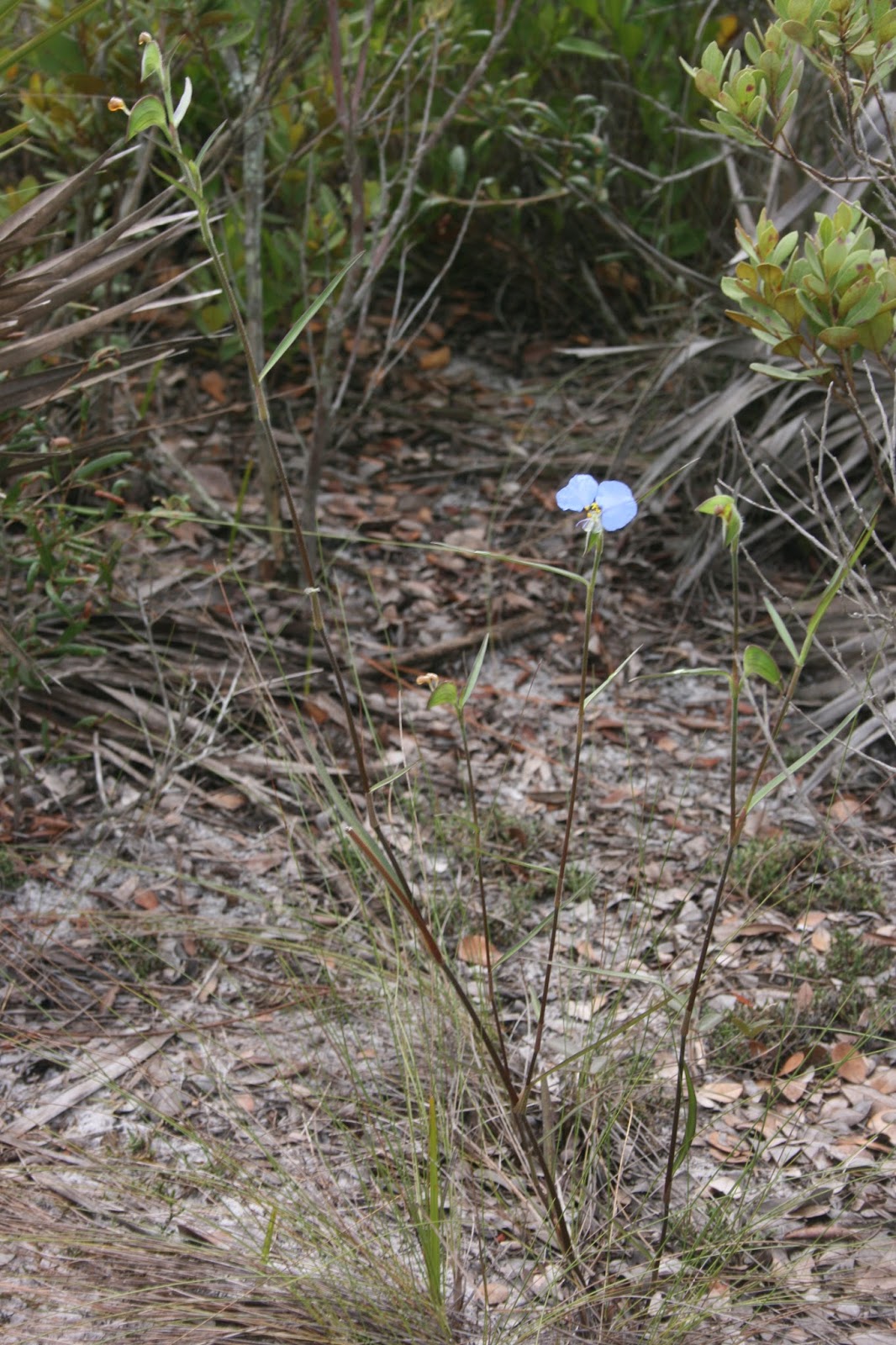
Erect Dayflower - Commelina erecta
Erect dayflower (Commelina erecta) occurs throughout Florida and nearly all of the United States except the extreme Northeast and Far West. This is a native species, common to a wide variety of dry upland sites. Most other native dayflowers are found in moister habitats and are not erect.
This is a perennial species, a close relative of the spiderworts and roselings, and shares the typical 3-petal flower shape. Dayflowers, as the common name suggests, have blooms that open for only one day, but produce a succession of flowers that keep plants in bloom for many weeks in the summer. Another common name for this species is "white mouth dayflower", so named because the lower petal is white instead of blue. It also is greatly reduced in size.
Dayflowers have a somewhat complex pollination strategy, but the blooms attract many kinds of bees and other pollinators. The seeds are produced in large numbers by late summer. The larger upper petals are a bright sky blue in color. This color is typical for this genus.
This is only 1 of 2 native dayflower species, but a great many nonnative species are common lawn weeds and residents of disturbed habitats. All possess foliage that is somewhat elliptical, with the sessile leaves clasping the main stem. This species is the only one likely to be encountered in xeric conditions, full sun, and upright in nature. Mature specimens bloom in mid to late summer. They typically reach a height of 18- 24 inches.
Florida Scrub Roseling - Callisia ornata
Florida scrub roseling (Callisia ornata) (fka Cuthbertia ornata) is endemic to the scrub and sandhill habitats of the Florida peninsula, south to Collier County. Roselings are very close relatives of the spiderworts (Tradescantia spp.) and the dayflowers (Commelina spp.), both very common almost weedy genera, but roselings are diminutive in comparison and not likely to ever be encountered in your lawn. The four native species in Florida are somewhat difficult to tell apart at first glance. Florida scrub roseling is distinguished by its very thin, grasslike leaves all the way up the stem and the fact that its flower scape is held well above the nearest leaves.
Roselings are annuals. Large numbers of seed are produced the previous fall. The tiny, grasslike plants emerge in the spring and eventually they form a basal rosette of bright green leaves. Each rosette is about 2 inches across.
In Florida scrub roseling, the flower stalk eventually reaches a height of about 12 inches. The bright 3-petal pink flowers each open for one day, in succession for several weeks. These blooms are visited by a wide variety of pollinators and the ripened seed is scattered below the parent by late summer/early fall. The flowers, above, were photographed in late June.
Roselings are not uncommon, but are difficult to distinguish when not in bloom. Their attractive pink flowers should lend them the qualities sought for landscape purposes, but their annual nature makes them very difficult to keep in a typical mixed wildflower bed. To persist, they need open, sandy soil and the ability to move about the bed. Since they aren't currently being propagated, it is best to simply admire their simple beauty as you hike Florida's most xeric habitats in mid-summer - a time too few of us get out to explore this amazing state of ours.
Subscribe to:
Posts (Atom)