Sunday, June 19, 2011

Pineweed - Hypericum gentianoides

Pineweed (Hypericum gentianoides) is another small St. John's-wort. Though it sometimes stands 18 inches high, it is a wispy plant with greatly reduced foliage and flowers that rarely are as much as 1/8 inches across. Pineweed occurs in deep well-drained sands throughout most of Florida and in well-drained uplands across most of eastern North America into Ontario. It is an annual forb and relies on its abundant seed crop to persist over time.
Pineweed does not look much like a St. John's-wort when not in bloom.  The single main stem gives rise to multiple brushy stems about 6 inches above the ground and gives the plant an almost bottlebrush appearance.  The leaves are greatly reduced and scale-like. 
Flowering occurs across the tops of the multiple stems in summer.  The petals are lemon yellow in color and each flower is composed of 5 petals.  They are not arranged in a whorl as are those in Highlands scrub St. John's-wort (H. cumulicola).
I have grown this species in my home landscape, but have not had much success with keeping it long term. Because of its annual nature, it would require well-drained sandy soils with sufficient open space for its seed to germinate in each spring.  In the landscape, this species is an interesting curiosity - not especially showy even in bloom, but intriguing when planted in small clusters and mixed with other small wildflowers near the front of the planting bed.
Look closely for it when hiking in open habitats during the summer.  You may have overlooked it in the past or not realized that it is a St. John's-wort.  Recognizing it for what it is, makes it a bit more special.

Pineland St. John's-wort - Hypericum suffruticosum

Pineland St. John's-wort (Hypericum suffruticosum)  is a tiny member of this large genus and one that could be easily overlooked in the understory. It occurs in moist to average pinelands in north Florida - across the panhandle and south to about Gainesville.  It is a plant of the Southeastern Coastal Plain, and occurs elsewhere from Louisiana to North Carolina.
Pineland St. John's-wort rarely stands taller than 6 inches. The unbranched multiple stems have simple leaves that remind me of those found in most Calamintha spp. mints - oval with a decided undercurl along the margins. 
The four-petal flowers open in June and occur atop the stems; normally only one is open at one time.  These are a light lemon yellow in color with the linear petals equidistant from each other.
Because of its small size and its understated beauty, this species has not been cultivated to the best of my knowledge and is not likely to be offered in the future.  I have never attempted it myself and do not know how far its natural range might be extended in cultivation. 
Look for it if you are hiking in north Florida in early summer. Though diminutive, it is another example of Florida's fascinating flora.

Roundpod St. John's-wort - Hypericum cistifolium

Roundpod St. John's-wort (Hypericum cistifolium) is one of the five-petal St. John's-worts and it occurs statewide in Florida in the edges of wetlands and in moist pine flatwoods and savannas.  In these habitats, it can be abundant.  Outside of Florida, this species occurs throughout the Southeastern Coastal Plain from Texas to North Carolina.
Roundpod St. John's-wort is distinctive.  It generally grows as a single stem and reaches a mature height between 2 and 3 feet.  The leaves are deep green, linear and the edges fold inwards.  These traits make it easy to identify, but because of its narrow growth form , individual plants tend to disappear into the background when they are not in bloom.
The flowers tend to occur mostly in early summer.  They are canary yellow in color, about 1/3 inch across, and produced in some abundance at the top of each stem.  The flowers also are held on distinctive stalks, unlike other species in our region.
Roundpod St. John's-wort is a wetland plant and does best in moist to wet soils, but like four-petal St. John's-wort (H. tetrapetalum), it is adaptable to most typical landscape settings if given partly sunny conditions and a bit of extra water during periods of extreme drought.  It has never been propagated (to my knowledge), however, by nurseries affiliated with FANN - the Florida Association of Native Nurseries, and it would be difficult to locate.  We do not propagate it at Hawthorn Hill either. 
Look for this distinctive St. John's-wort in flatwoods and open savannas in summer and enjoy its simple beauty.

Saturday, June 18, 2011

St. Peter's-wort - Hypericum crux-andreae


St. Peter's-wort (Hypericum crux-andreae; incorrectly -  H. stans) is yet another member of this genus with four-petal flowers. The blooms are extremely similar to St. Andrew's-cross (H. hypericoides), but the petals seem to be a bit wider. This species occurs in wetlands throughout much of Florida (except the extreme southern counties) and in much of the Southeast and Mid-Atlantic states.
St Peter's-wort is an irregular, open woody shrub that may reach 3 feet at maturity.  At the more northern regions of its range, it is deciduous and leafs out in early spring.  The foliage is reminiscent of myrtle-leaf St. John's-wort (H. myrtifolia), but the oval clasping leaves are a bit more greenish and less blue-green than the latter.
Flowering occurs in our Pinellas landscape in early summer.  The canary-yellow petals are thin, arranged in an "X" pattern and ocur at the tips of the many thin branches.  They are attractive, but not in the profusuin seen in some other species in this genus.
This species requires moist to wet conditions and should not be attempted in drier landscapes. It also seems better suited to filtered sun than full.  We have only grown this species for a short time at our Pinellas County location and I do not yet have enough experience with it to profess myself an expert.  I am not aware of anyone that has ever offered it for sale within Florida. With enough diligence, however, it may be possible to locate specimens from states adjacent to Florida. With all of the other wonderful wetland species here, this effort may not be justified. 

Myrtle-leaved St. John's-wort - Hypericum myrtifolium


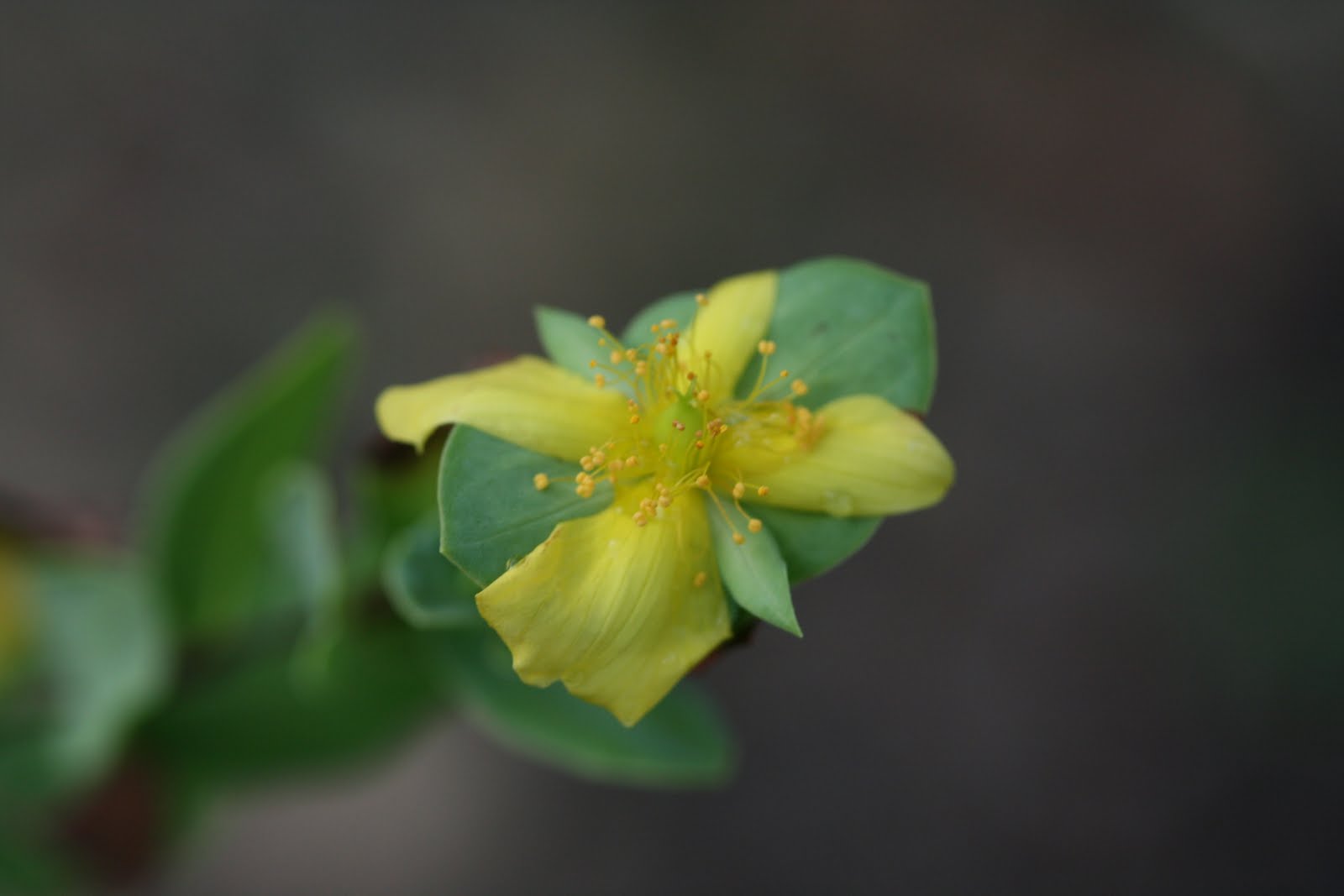
Myrtle-leaved St. John's-wort (Hypericum myrtifolium) has foliage that looks somewhat similar to that of four-petal St. John's-wort (H. tetrapetalum), but the flowers of this species have five petals.  Myrtle-leaved St. John's-wort is a wetland species; found in a variety of locations nearly statewide.  It is confined to the Deep South and occurs only in nearby states -Alabama to South Carolina.
This is an evergreen woody shrub that may reach about 3 feet tall. The branches are thin and the plant has an irregular aspect.  The opposite leaves clasp the stems, are triangular in shape and blue-green in color.  This is one of many species in this genus to have exfoliating bark.  In mature specimens, it peels away from the main stem in noticeable sheets.
Flowering is confined mostly to the spring. Individual flowers are showy. The five petals are a rich yellow color and the mass of pollen-producing anthers add to their interest.  
In my experience, this species requires wet soils to prosper.  Plants I have used in my Pinellas County landscape have failed when planted in soils that sometimes dry out for more than the briefest of periods.  If a wet area is available, however, this is an extremely showy species that does not take up too much space.  Regrettably, it is only rarely offered by commercial nurseries for the home landscape.   Should you locate a source, use it at the edge of ponds or shallow wetlands. Plant it in mass as individual plants are rather thin and to take advantage of its showy blooms. 

St. Andrew's-cross - Hypericum hypericoides

St. Andrew's-cross (Hypericum hypericoides) is another common St. John's-wort with flowers that have only four petals.  Unlike four-petal St. John's-wort (H. tetrapetalum), however, the petals of this species are arranged in an "X" pattern, where the petals are not equidistant from each other.
St. Andrew's-cross is tolerant of a wide variety of growing conditions and can be found in the upper edges of wetlands and in mesic understories throughout Florida and in much of the eastern U.S.  In Florida, it is an evergreen woody shrub with a narrow regular aspect and a somewhat rounded crown.  Mature specimens can reach 3-4 feet in height.  The stems and trunk are narrow and the back is cinnamon brown in color.  The opposite leaves are linear and bluish green.  It makes a nice foliage plant in the home laqndscape.
Flowering is most common in the spring, but blooms are evident during most months.  The flowers are rather small and the petals are narrow.  Though attractive, they also tend to be hidden somewhat in the foliage.
St Andrew's-cross is an easy species in the home landscape.  It adapts to nearly every growing condition and is relatively long-lived for the genus.  In our landscape at Hawthorn Hill, plants have seeded into many parts of our landscape and we have to do some limited thinning each year to maintain them in the areas we most want them.
Despite this species' adaptability, it is only infrequently offered by commercial nurseries affiliated with FANN - the Florida Association of Native Nurseries.  We always have seedlings we could pot up at Hawthorn Hill, however, if you ask. Should you locate it for your landscape, use it as a screen at the back of a landscape bed or in scattered clusters in expansive settings. 

Four-petal St. John's-wort - Hypericum tetrapetalum

Four-petal St. John's-wort (Hypericum tetrapetalum) occurs statewide in Florida; primarily in moist soil habitats, but also in upland ecotones where soils are occasionally more droughtly.  This is a near endemic and found outside of Florida only in parts of southern Georgia.
Four-petal St. John's-wort is an evergreen woody shrub that may reach a mature height of about 3 feet.  It is an openly branched species with thin stems and oval blue-green leaves that clasp the branches.  It assumes an irregular aspect with the leaves most confined to the branch tips.
As its common and Latin names suggest, four-petal St. John's-wort produces flowers with four canary-yellow petals.  They are showy and about 1/2 inch wide.  Flowering can occur in most months, but is most common in late spring.  Well-grown specimens may have a dozen or more blooms at any one time.
Four-petal St. John's-wort is one of the better members of this genus for the home landscape.  Although it is naturally found in wet to moist locations, it adapts well to most typical  home landscape conditions, except excessively droughty soils.  In our Pinellas County landscape it has done well in a variety of settings, but seems to prefer partial shade when planted in soils that often dry out.  It has spread in parts of our landscape by seed, but never aggressively.
This species is only occasionally offered for sale by nurseries affiliated with FANN, the Florida Assocation of Native Nurseries.  If you locate a source, use this plant in mixed plantings in the back half of the bed and cluster 3-5 plants together.  Once it is established, it should be an easy plant to maintain.