Thursday, October 16, 2014

Chipola coreopsis - Coreopsis integrifolia


Chipola coreopsis (Coreopsis integrifolia) is quite rare in Florida, listed as a state endangered species and vouchered only from 5 counties - all along the Georgia border.  The primary distribution is along the Chipola River in Jackson, Calhoun, and Washington Counties in the central panhandle.  This species is rare elsewhere in its national distribution.  It is listed as a state threatened species in Georgia, where it is found in only four counties near the Florida border, and it is considered an "at risk species" in South Carolina where it is known from only a few southern counties.  In all its natural populations, it occurs in floodplain wetlands, along blackwater streams, where it receives dappled shade and plenty of moisture.
Florida is home to 15 species of coreopsis (tickseeds) and they can sometimes be a bit tricky to differentiate.  Chipola coreopsis is a perennial that dies back to the ground each winter.  In spring, it forms basal rosettes that can spread in all directions by underground rhizomes.  The stems eventually reach a mature height of about 2 feet by late summer.  As the plants spread, multiple flower stalks are common.  They have few branches, but each is topped by a single flower comprised of bright yellow ray petals and a dark central disk.  The flowers are about 18 inches across and each ray petal has three teeth at their outer margin.  Flowering only occurs in late summer to fall.
The foliage is distinctive.  The 1-3 inch long somewhat succulent leaves are opposite each other on the stem, the leaves occur along the entire length of the stem, and they are oval in shape and without teeth along the margins.  As the Latin name implies, the leaf margins are simple.
Chipola coreopsis is quite rare, but is infrequently offered by native plant nurseries.  I have not found it to be an easy species to maintain in the home landscape. It is fussy about its growing conditions. Do not attempt it unless you can give it dependably moist soils and filtered sun.  Under such conditions, it is an attractive fall wildflower that can form stunning masses of color.

Tuesday, October 14, 2014

One more chance this fall to purchase wildflowers from Hawthorn Hill Native Wildflowers, in Seminole, FL. We need to make room before winter for all our new seedlings so we are having a FALL OPEN HOUSE, Sunday October 26, 9 am - 1 pm.  All plants will be reduced.  Please make plans to stop by, see our landscape and pick up some uncommon native wildflowers.  This is the best time to plant!  Email me for directions, or any questions you might have: huegelc55@aol.com


Sunday, July 20, 2014

Lindenleaf Rosemallow/Sleepy Hibiscus - Hibiscus furcellatus


Sleepy hibiscus (Hibiscus furcellatus) is a tropical species that occurs naturally in Florida only along the eastern coastal counties, from Brevard to Broward County - with an inland population in Highlands County. It occurs widely in more tropical locations, however, throughout much of the West Indies and parts of South America and is considered native in Hawaii. It's range seems to be largely restricted by winter freezes.
Sleepy hibiscus is a lanky perennial that can reach 6 feet at maturity. As a tropical species, it is evergreen and can bloom much of the year. The photos above were taken in mid-July at my Pinellas County residence. Other writers report that it becomes shrubby, as wide as it can be tall, but the plants I've observed have been rather thin with multiple side branches. The leaves are shallowly lobed, more like a maple than a linden (basswood - Tilia spp.), and somewhat rough to the touch.  The stems also have stiff hairs.
Sleepy hibiscus is so named because of its nodding, half-open blooms. They are bright pink in color with a deeper rose-colored throat. Each is 6-8 inches long and quite showy. Their "sleepy" aspect makes it somewhat difficult for butterflies to pollinate them, but they are visited by bees - and hummingbirds in parts of their range.
Sleepy hibiscus is most common to the upper edges of south Florida pinelands and wetlands where they are shallowly inundated during the wetter months. Though not as needy of standing water as many of our native hibiscus, it prefers moisture - especially during the hotter months. It is reported to fare reasonably well in typical upland landscape conditions, but I have found it to need supplemental water if the soils become dry.
Regrettably, this species is only rarely offered for sale in Florida.  Currently, no nursery affiliated with FANN- the Florida Association of Native Nurseries, is propagating it and I have not seen it offered for at least a decade.  The plants above, were grown from seed collected several years ago in a wet flatwoods in St Lucie County. We hope to be able to propagate it from the seed of our plants this fall to make it available in Spring 2015. Inquire if interested.

Wednesday, July 2, 2014

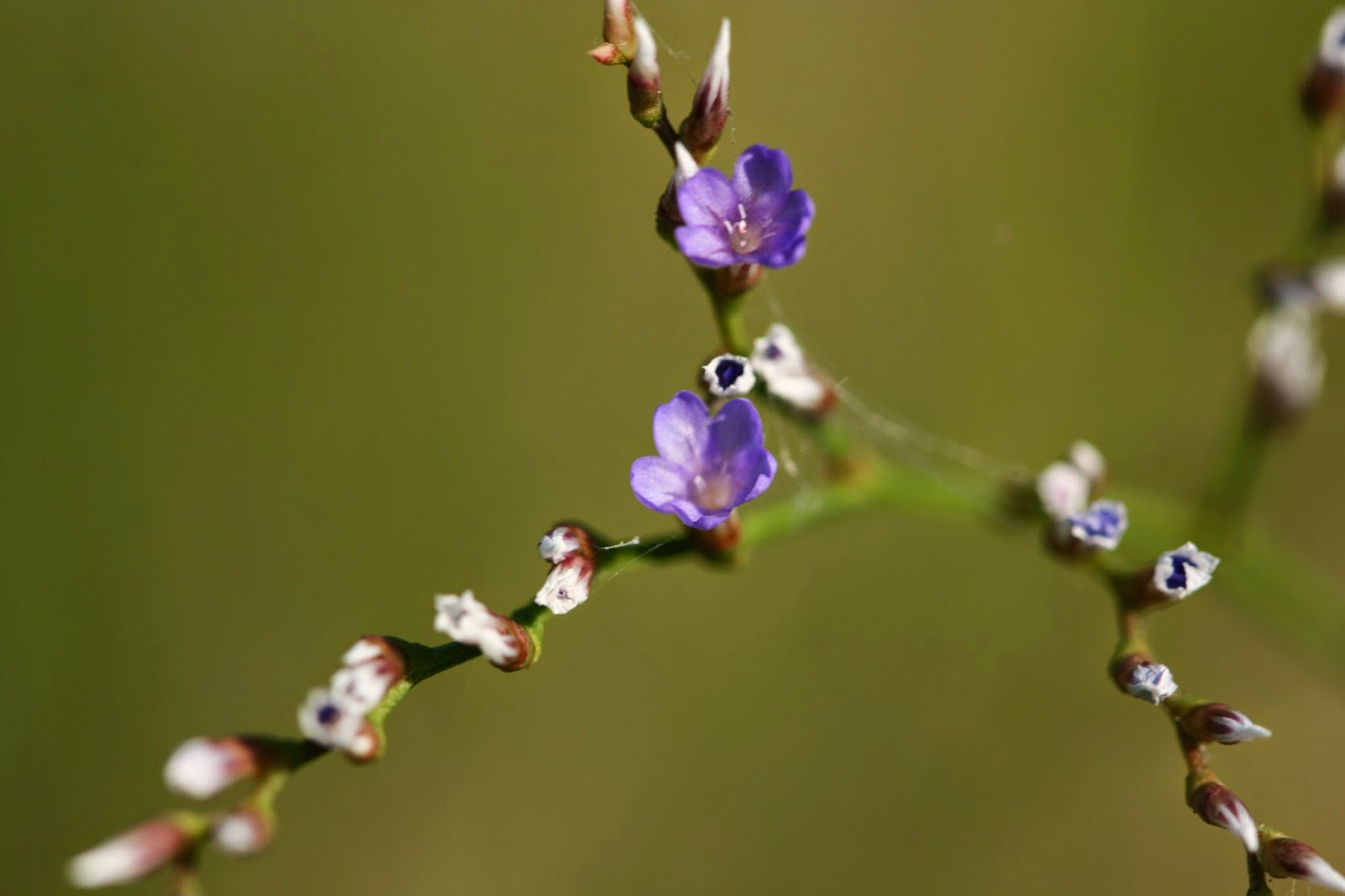
Sea Lavender - Limonium carolinianum


Sea lavender (Limonium carolinianum) is native to the coastal marshes of every coastal county in Florida and those of the Gulf Coast and Eastern Seaboard, from Texax to Quebec and Labrador/Newfoundland.  It is highly salt tolerant and tolerates daily inundation during high tides.
Sea lavender is a perennial forb. In Florida, it tends to keep its basal leaves through winter. These are variable in shape, but most frequently are lanceolate and rather succulent in appearance.  The multi-branched, nearly leafless flower stalks arise from these leaves and stand about 2 feet tall.  Flowering is most common in spring and in fall, but can occur in most months in central and southern Florida.  Numerous 5-petal blooms are produced for many weeks, a few at a time.  As the common name implies, they are a rich lavender in color. Though each bloom is small (about 1/8 inch across) and opens for only part of the day, plants during the peak blooming season are quite attractive.
Because of its habitat preferences, sea lavender is only sporadically grown by commercial sources and it does not lend itself to the typical landscape setting.  It would make an interesting and attractive addition to a salt marsh restoration or for landscapes on the beach that receive direct saltwater inundation.

Saturday, June 28, 2014

Pale Meadowbeauty - Rhexia mariana


Pale meadowbeauty (Rhexia mariana) occurs nearly statewide in Florida in open savannas and marsh edges.  It also is common throughout much of the eastern half of the U.S.  Within this region, flower color can be variable, from the nearly white form pictured above to pink (a color common to many other meadowbeauties). The flower-color variability could make identification confusing, but this species has very conspicuous "hairs" along the stems. It is very similar to R. nashii, but the hypanthium (the tube portion of the urn-shaped seed capsule) is much longer in the latter.
This is a perennial herbaceous wildflower that often dies back to the ground each winter and reemerges in the early spring. Mature plants reach a height of 2-3 feet by summer. The leaves are linear and opposite each other on the very hairy stems.  Like other members of the genus, pale meadowbeauty forms extensive colonies by underground stems.
Flowering occurs in early summer to fall.  The four broad petals recurve slightly backwards and the overall flowers are about 1 inch across.  The stamens end in conspicuous yellow curved anthers and, following pollination, the urn-shaped seed capsules are distinctive.
Meadowbeauties, as a genus, are only rarely propagated and sold commercially.  All make wonderful additions to a moist-soil setting, if provided sun to mostly sunny conditions.


Zigzag Spiderwort - Tradescantia subaspera


Common spiderwort (Tradescantia ohiensis) is so common in Florida that we sometimes forget our state hosts other species.  Zigzag spiderwort (T. subaspera) is one of those. Zigzag spiderwort is found in Florida only in the central Panhandle, in a four-county area around Torreya State Park and Apalachicola National Forest.  It also occurs to our north, across much of the Midwest to the Northeast. In nature, this spiderwort occurs in partial to nearly full shade beneath the understory of upland deciduous woodlands.
Zigzag spiderwort is a perennial herbaceous species that dies back to the ground each winter and reemerges in spring.  Mature plants are a bit lanky and stand 12-18 inches tall by early summer.  Although it looks a lot like common spiderwort, one distinct difference is in the foliage. Zigzag spiderwort's leaves are much broader at the point of attachment to the stem than they are elsewhere. In common spiderwort, the leaves are pretty much uniformly the same width throughout.
The flowers of zigzag spiderwort are similarly shaped to common spiderwort, but tend to be much smaller in size.  In all of the plants I have seen, they are light blue in color and there does not seem to be the variability in shades of blue present in common spiderwort.
Although zigzag spiderwort is tough and adaptable to a wide variety of growing conditions (provided it is not planted in full sun), it is not currently propagated by anyone associated with the Florida Association of Native Nurseries (FANN) and it seems unlikely to be anytime soon. This would be an interesting addition to a shade garden as so few wildflowers bloom in summer in shady settings.

Monday, June 23, 2014

Chapman's Crownbeard - Verbesina chapmanii


Chapman's crownbeard (Verbesina chapmanii) is another interesting Florida plant, endemic to a 6-county area in the central Panhandle.  Its core population is found within the Apalachicola National Forest, where these photographs were recently taken.
Chapman's crownbeard is a perennial forb with rough-as-sandpaper oblong leaves that vary in length from 1-4 inches.  The leaves alternate on the wingless 2-3 foot tall stems. Rounded flower heads form atop these stems in late spring and early summer. Each head is about 3/4 inches across. The bright yellow flowers are quite distinctive; no ray flowers are produced and they appear similar to those produced by Palafoxia spp.- except for the canary yellow color. Like other members of the aster family, the blooms attract pollinators.
Chapman's crownbeard occurs in open wet prairies, pine flatwoods, and bogs and forms an interesting part of the extremely diverse wet-prairie habitats found throughout the Apalachicola National Forest and parts adjacent to it.  Though several members of this genus have become common cultivated wildflowers in Florida, Chapman's crownbeard has never been offered for home gardens to my knowledge. I suspect it is somewhat adaptable, but have never grown it myself to verify that.  Watch for it along roadsides in moist open areas of the Forest and admire it for its simple beauty.