Sunday, May 6, 2012

St. Peter's-wort - Hypericum mutilum


St. Peter's-wort (Hypericum mutilum) may be the most overlooked member of this large genus in Florida. Though the plants themselves are large enough, the tiny yellow flowers are noticeable only on close inspection.  And, when that happens, it is easy to see that this species is, in fact, a St. John's-wort member.
St. Peter's-wort occurs throughout Florida and in nearly every state and province of North America. Throughout this range, it is most frequently encountered in moist, open habitats - the upper edges of marshes and low pockets in pine flatwoods, especially.  St. Peter's-wort is an annual (sometimes a very short-lived perennial), but in Florida it reaches blooming size by late April to early May.  Mature plants are seldom taller than 2 feet and they tend to be rounded in shape - sometimes taller than wide.  The oval leaves are opposite each other on the stem and they clasp the stem. The bark on the lower, more-developed stems is cinnamon colored and peeling.
Like other members of this genus in Florida, the flowers are yellow - a pale lemon yellow instead of a deep canary color.  Each bloom is no more than 1/3 inch across and has 5 petals arranged  in a starlike pattern - not whorled like a pinwheel.  These attract very small pollinators.
St. Peter's-wort is not likely ever to be the subject of landscape interest because of its annual nature and its tiny flowers, but it is an interesting species nevertheless.  Look for it as you hike outdoors anywhere in Florida at the edges between upland and wetland.  If you haven't noticed it before, I bet you will find it if you look for it.

Saturday, May 5, 2012

Grassleaf Yellow Star Grass - Hypoxis juncea


Grassleaf yellow stargrass (Hypoxis juncea) is a diminutive member of the Hypoxidaceae family, though it has at times been included as an iris and as a lily. Regardless, it is a monocot - like the lilies, irises, and amaryllises and arises each spring from a tiny bulb. Grassleaf yellow stargrass is common to most of Florida, in moist woodlands. Its national range is restricted to the Deep South - from Alabama to North Carolina. In Florida, it is most common in wet to seasonably moist pinelands.

Yellow stargrass is a perennial that dies back to the ground during a brief period in winter. In warm years, however, it is possible to find it in bloom at any time. Slender grass-like leaves extend about 6-12 inches from the bulb, but often lie near the ground instead of standing upright.

A single yellow flower is produced at any one time, though individual plants may produce more than one flower during the year. These are bright canary-yellow in color, about 1 inch across and consist of six petals in a star-shaped arrangement. Flowering in the southern half of Florida can occur during any month, but is often confined to spring through fall elsewhere. The flowers are showy, but are held close to the ground.

Yellow stargrass is not available commercially to the best of my knowledge and we do not propagate it at Hawthorn Hill. If you had access to a source, it should be used in an open sunny, moist setting that does not stay dry for long - especially during the hot summer months. Use it in the front of a garden and make sure it does not get crowded out by taller more-aggressive species.
Look for yellow stargrass any time you are hiking in flat open areas in Florida. You may have to look close for it, but once your eye is trained to see it, I expect you will see it often.

American Squawroot - Conopholis americana


American squawroot (Conopholis americana) is the only member of this genus in Florida and part of a family (Orobanchaceae) that acts as root parasites.  American squawroot is also in the smaller group in this family that does not produce chlorophyll - making it completely dependent on its host for its nourishment.  This is a widely occurring species in Florida, and can be found throughout most of the northern half of the state.  It is also widely distributed outside of Florida.  American squawroot is found from Manitoba in central Canada to our north and south to Mississippi.  Throughout this range, it is most often found in the understories of well-drained woodlands.
American squawroot is deciduous and emerges in the spring.  It does not have leaves and produces a cluster of pine-cone-shaped flower heads in early spring to early summer. The plants photographed above were just past their peak of flowering in early March.  The individual flowers are yellowish white. They are subtended by an orange-tan bract. I have not observed the types of pollinators that visit this plant, but suspect it is of most interest to bees and pollinating flies.
American squawroot is never likely to be the target of home landscaping interest, but it will always remain an interesting component of our flora. Look for it in the understory of well-drained oak woodlands and admire it for its unique character.

Wild Comfrey - Cynoglossum virginianum


Wild Comfrey (Cynoglossum virginianum) is rare in Florida, found only in Gadsden and Liberty Counties in and around Torreya State Park.  As such, it has also been classified as a state endangered species. Like so many of our natives, confined around Torreya, it is much more widely distributed elsewhere outside of Florida. Wild comfrey is distributed north to Quebec and the Yukon in Canada, and westward in the U.S. to the Dakotas and Texas.  In Florida, wild comfrey occurs in the understory of deciduous hardwood forests. Here it blooms before the canopy closes and it gets protection from the summer sun after flowering has past.
Wild comfrey is a perennial herb in the Borage family.  It dies to the ground each winter and emerges in the spring.  For the most part, it exists as a basal rosette of broadly oval, fuzzy leaves.  Each is nearly 8 inches long and about 4-5 inches wide.  A flower stalk is produced from the center of this leaf cluster in spring and it eventually stands 2-3 feet tall.
Flowering occurs in March to very early April in Florida.  Each flower stalk has several side branches and each has a small cluster of small flowers.  Most often, these flowers are pale blue in color, but some are nearly white and a few are almost pinkish. 
Wild comfrey has never been offered for sale by any of the nurseries associated with FANN- the Florida Association of Native Nurseries and it is unlikely to be offered in the future.  As a relict species, wild comfrey is not widely adaptable to most Florida landscape settings. I have not tried to propagate this species though I suspect it could be found from commercial sources outside Florida.  In my opinion, this species is just another good example of an interesting part of our flora that should be looked for in the right places and admired there.

Friday, May 4, 2012

The New Book is Here!

Just received my copies from University of Florida Press!  Cover by my friend, Christina Evans.  If you purchase a copy, I sincerely hope it is helpful in your gardening efforts.  Please let me know.  I enjoyed the writing and photographing part, but the real test is whether it actually helps you all.


Saturday, April 28, 2012

Mohr's Barbara's Buttons - Marshallia mohrii - NOT NATIVE TO FLORIDA


I made an exception for this very rare plant because my pictures turned out pretty well and I thought it worthwhile to post them and the narrative below.
Mohr's Barbara's buttons (Marshallia mohrii) is both rare and endangered throughout its limited range - Floyd County Georgia, in the extreme northwest section of the state) and a few counties in adjacent northeast Alabama. In this restricted geographic range, it occurs in rocky outcrops and in shallow upland soils in open sandy pinelands and roadside cuts.  In these areas, it is adapted to relatively high light levels and occasional drought.
Mohr's Barbara's buttons is an erect perennial herb that dies back to the ground each winter. It emerges early and eventually reaches a mature height of 1-2 feet.  Unlike a few other closely related species it branches up the stem and produces multiple flower heads. The leaves are a bright shiny green and narrowly elliptical.  The lower leaves may be more than several inches long, but leaf size decreases markedly up the stem.
Flowering occurs in late April through early June, depending on the severity of the preceding winter.  This is an aster, but the heads do not contain ray flowers - only disk flowers.  These open along the outside of the bud first. Each is a pale pink to white in color. The five petals twist above the fused tube.
Mohr's Barbara buttons is a beautiful and interesting plant, and one that attracts pollinators. Despite its rarity, it is sometimes offered for sale by licensed native plant nurseries. The one photographed above was purchased by one of those and is growing in a large landscape pot with some Bartram's ixias (Calydorea coelestina) in our Pinellas County, Florida landscape at Hawthorn Hill.  We do not intend to propagate it ourselves, as it is not native, but we certainly appreciate its beauty.

Tuesday, April 17, 2012

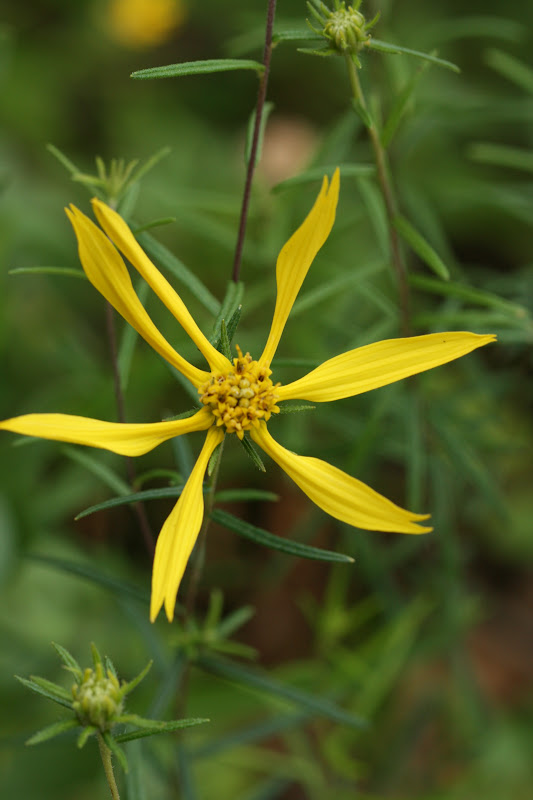
Narrowleaf Phoebanthus - Phoebanthus tenuifolius


Narrowleaf phoebanthus (Phoebanthus tenuifolius), sometimes also called pineland false sunflower, is a rare endemic version of Phoebanthus grandiflorus - a more widely distributed endemic found in the southern two-thirds of the peninsula.  Narrowleaf phoebanthus is found only in five counties along the Gulf Coast "bump" in the panhandle, in mesic to xeric open pinelands. The plant photographed above was located within the Apalachicola National Forest. Because both Phoebanthus species sucker extensively from underground rhizomes they tend to form expansive colonies wherever they are located.
Narrowleaf phoebanthus is geographically isolated from its close cousin.  There is no overlap in populations so it is not possible that you could get them confused.  As its name implies, it has extremely narrow foliage. It also has thinner petals in its flowers.
Narrowleaf phoebanthus is a deciduous perennial.  It dies back completely in the early winter, leaving nothing above ground except its dead stems. In early spring, it re-emerges and quickly reaches a mature height of 2-3 feet.  Each plant produces multiple stems from a single woody rhizomatous root.  It also suckers, so colonies are common.  The thin leaves, alternate along the wiry stem, are no wider than 1/8 inch. Both the foliage and the stems are covered by wiry hairs and feel rough to the touch.
Flowering occurs a bit earlier than it does for P. grandiflorus; often by late April or early May.  A single large sunflower-type bloom emerges from the top of each stem.  Once the plant becomes established and forms multiple stems, the patch of "false" sunflowers is very attractive.  They are also attractive to bees and butterflies.
Narrowleaf phoebanthus occurs in well-drained soils in sunny locations.  In the landscape, it needs pretty much the same conditions.  Do not let it get too dry, but never plant it in soils that do not drain well or in locations that receive less than 1/2-day of sun.  Regrettably, it has never been propagated commercially by anyone associated with the Florida Association of Native Nurseries (FANN) and has, therefore, been nearly impossible to add to a home landscape.  We, at Hawthorn Hill, have recently added it to our Pinellas County landscape and hope to be able to collect seed from it this summer.  If you are interested, let me know and I'll keep you up to date on our progress.