Sunday, May 8, 2022

Heart-leaved Meadow Alexander - Zizia aptera


Heart-leaved meadow alexander (Zizia aptera) is a perennial wildflower recorded only from Holmes and Calhoun Counties in the Florida Panhandle though it is widespread throughout much of the eastern and upper western states of the U.S.  Throughout this region, it occurs in the semi-shaded and moist understories of deciduous woodlands. It is easily distinguished from its more-common and sometimes propagated relative (Z. aurea) by its heart-shaped basal leaves.  Both are members of the carrot family (Apiaceae) and are often reputed to be hosts for the eastern black swallowtail. Though this may be the case, neither plant is listed as such in most of the references I have.

Heart-leaved meadow alexander emerges in the early spring and reaches its mature height of 1-3 feet by April to early May.  Like other members of this genus, it produces a broad crown (2-3 inches across) of golden-yellow tiny flowers on a compound umbel.  These are aesthetically attractive, but also draw the attention of small bees, syrphid flies, and butterflies.  Small dark-brown seeds mature by summer and can be used to propagate additional plants. Like other "carrots", sow these seed just beneath the soil.

This is a rare plant in Florida and not likely to be propagated in the future by native nurseries here, though it may be possible to find seed from out-of-state sources. As its close relative, Z. aurea, is often available, it would seem best to rely on it for landscape uses. 

The photos above were taken by my friend Lily Byrd and are used with permission.

Thursday, April 7, 2022

Florida Phlox - Phlox floridana


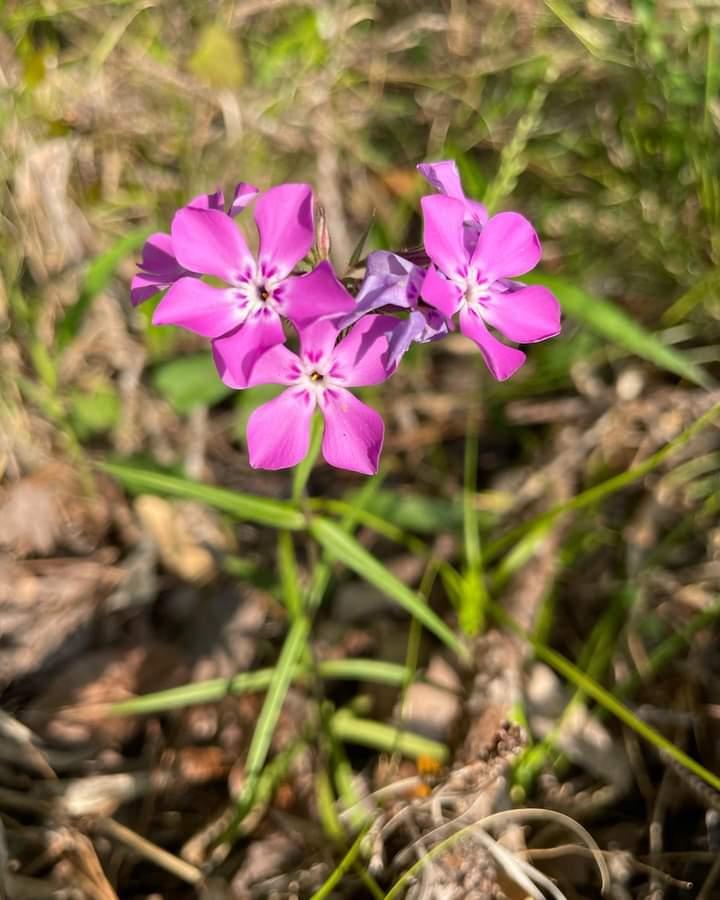
Thanks once more to my friend, Lily Byrd, I have these photos of a plant I have not previously added to add to my blog.  Florida phlox (Phlox floridana) is very similar in appearance to one I have written about previously - downy phlox (P. pilosa) and can be distinguished only by examination of the leaves just below the inflorescence.  In downy phlox, these leaves remain spreading and at right angles to the main stem while in Florida phlox they become ascending and grade into the bracts below the flowers. Otherwise, they are quite similar and are found in much the same regions of Florida.

Both species occur in open, well-drained habitats from north Florida south into north-central counties, though downy phlox is more common as you move southward. Florida phlox also has a much reduced range nationally and is a near endemic; it has been reported outside of Florida only in a few counties in extreme southern Georgia and Alabama.  

Like its close cousin, it is perennial that dies back to the ground in winter and emerges again in early spring. Individual plants eventually reach a mature height of about 12-15 inches. Flowering occurs mostly in spring, though individual blooms can occur throughout the summer. Flowers range in color from a vivid pink to paler pinks and light lavenders.  Each flower is about 3/4-inches wide.
For some reason, only woodland phlox (P. divaricata) is routinely propagated in Florida by members of FANN - the Florida Association of Native Nurseries.  This should be corrected someday as all of our perennial native species make wonderful additions to home landscapes. They add color and are of value to pollinators - especially butterflies.

Wednesday, March 30, 2022

Southern Stoneseed - Lithospermum tuberosum


Thanks to my brilliant naturalist friend, Lily Byrd, I have the photos of this wonderful wildflower to share with all of you. Southern stoneseed or tuberous gromwell (Lithospermum tuberosum) is a native member of the borage family and found sporadically in nine counties in north-central Florida.  It is a perennial that dies back to the ground each winter and emerges in early spring from a very thickened tap root as a set of "hairy" basal leaves. It is a common wildflower of the Piedmont region of Georgia to the Carolinas and north to Virginia and extends west to east Texas. In this region, it is most common in the understory of rich deciduous woodlands.

The flower stalks emerge in mid-spring and can reach a mature height of about 2 feet. The leaves along these stems are much reduced in size, but remain elliptical in shape and alternate on the stems. Flowering occurs from mid-March to early June in Florida. It has the typical borage inflorescence - flowers open in sequence along a flower stalk that curves as it grows. The individual flowers are a light lemon yellow in color and decidedly tubular in shape.  I have not seen pollinators using it firsthand, but suspect that they are favored by a variety of bees while the woodland canopy remains open - like other borage species.

Southern stoneseed has never been propagated for sale by any of the nurseries affiliated with FANN - the Florida Association of Native Nurseries, to the best of my knowledge. It would be an interesting plant to add to a deciduous woodland planting in north to central Florida, but that would have to wait for someone to propagate it. I do not grow it here at Hawthorn Hill.  For now, we must simply admire it if we are lucky enough to come across it while hiking in those counties where it does occur.

Monday, March 7, 2022

Round-lobed Liverleaf - Anemone americana (FKA Hepatica americana)


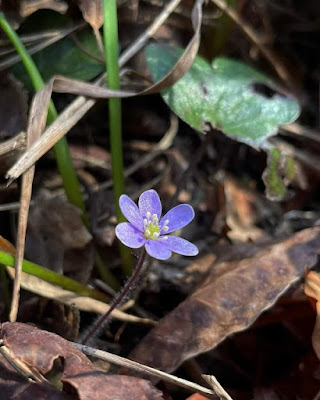
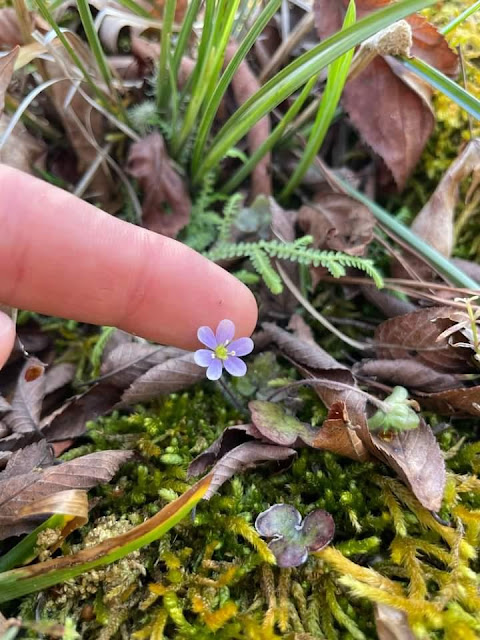
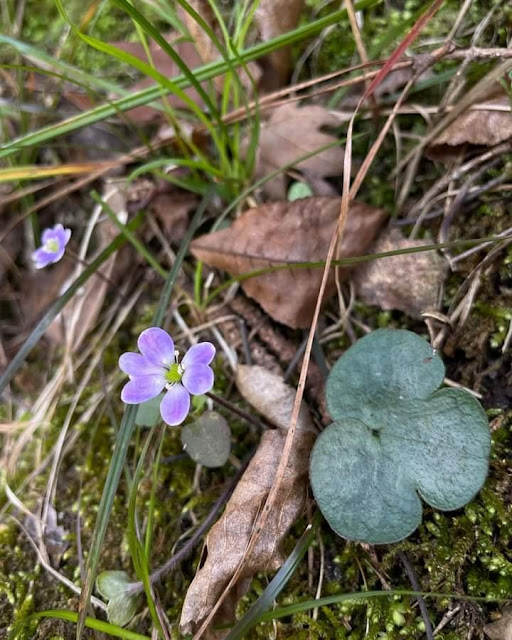
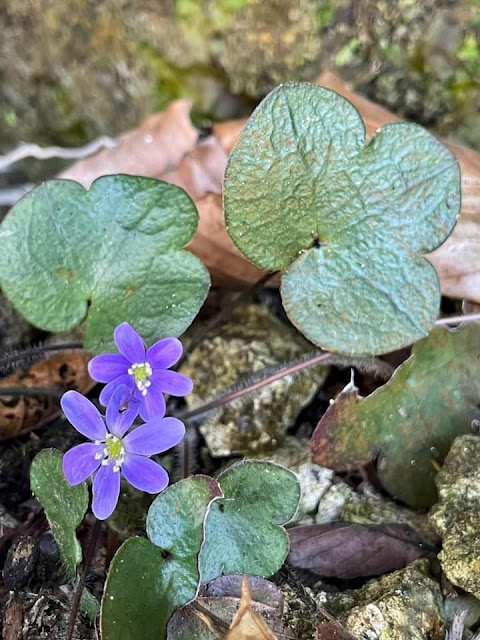
Round-lobed liverleaf (Anemone americana) is an exceedingly rare plant in Florida - found only in two counties (Jackson & Gadsden) in and around Torreya State Park in the central Panhandle.  It is classified as a state-endangered species. It also has recently undergone a taxonomic change as I learned it as genus Hepatica. This change has been back and forth over the years and you are just as likely to find it referenced as Hepatica as you are Anemone if you search for it online.  The two genera are very closely related.

This spring-blooming ephemeral perennial wildflower is a relic in Florida of earlier geologic time. Like so many of these types (bloodroot, columbine, mayapple, etc.) they are indicative of rich woodland soils of the type you might find in more-northern states. It is, in fact, native to every state east of the Mississippi River and Canadian provinces from the maritime east to Manitoba west. Throughout its vast range it makes its appearance in the early spring, blooms and "disappears" soon after for the remainder of the year.

As its common and former Latin name suggest, its foliage is comprised of rounded lobed leaves - somewhat suggesting the thalli of liverworts.  These leaves are arranged in a cluster that rarely stands taller than 8 inches above the ground.  The margins of these leaves are without teeth, but have hairs on the leaf stems.  Each leaf is 1-3 inches wide and 1-3 inches long.  They are easy to miss when this plant is not in bloom.

Blooming in Florida occurs in early March. Flower color can be variable - from nearly white to a rich purple.  Each is about one inch wide and composed of 6 tepals - the petals and sepals look alike. Although this is a characteristic of many monocots, the buttercup family (Ranunculaceae) of which this species is a member is considered to be a dicot.  

This is an easy wildflower to find in wildflower catalogs from states to our north. Such plants are very unlikely to thrive in Florida, however. The Florida ecotype has never been offered for sale here to the best of my knowledge.  It would have to be grown in a deciduous woodland understory in rich soil.  If you are lucky enough to witness it here in Florida, simply admire it for its perseverance. Not everything beautiful in Florida makes a good landscape choice.

The photos of this wildflower were taken by my friend, Lilly Byrd, who is active on both Facebook and Twitter. I encourage you to follow her.


Friday, December 17, 2021

Hammock Snakeroot - Ageratina jucunda


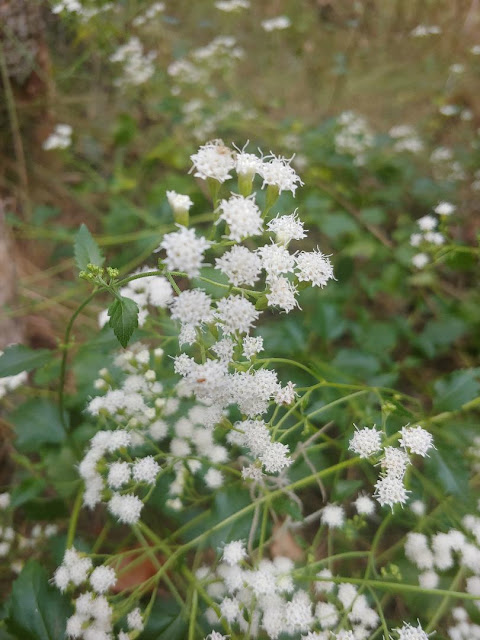
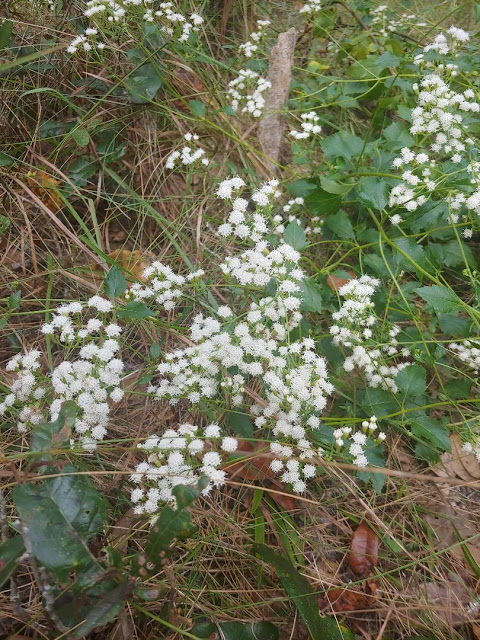
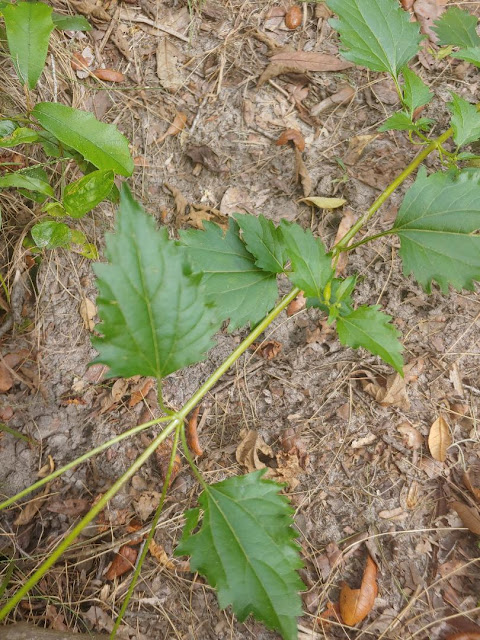
Hammock snakeroot (Ageratina jucunda) is a common perennial wildflower native to open xeric to mesic woodlands throughout Florida except for the western Panhandle region.  It often is found in partly shady locations, but tolerates high sunlight. Its stems die back to the ground in late winter and it begins sending its 2-3 foot stems upwards in spring.  These stems are glabrous while the arrow-shaped leaves are opposite on the stem. Each leaf is 1-1 1/2 inches long and noticeably toothed.  

Flowering occurs in the fall and lasts until early winter, They are arranged in small individual heads that are further arranged in an almost-corymblike structure.  The flowers are bright white in color and quite attractive at their peak. Hammock snakeroot also attracts the attention of a great many pollinators at this time.  

Although this plant is quite adaptable and has great value to a pollinator garden, it is only offered sporadically by nurseries affiliated with FANN - the Florida Association of Native Nurseries.  It is easy to propagate from seed, however. Scatter it just below the soil surface. Once established, it often self-sows in the landscape.

Sunday, November 14, 2021

Carolina Scalystem - Elytraria caroliniensis


Caroliana scalystem (Elytraria caroliniensis) is a perennial herb found statewide in a variety of moist habitats.  It also is found in Georgia and South Carolina. It is a member of the Acanthaceae and, therefore, related to species in Ruellia, Dyschoriste, and Justicia genus.  Though many of these are cultivated for home landscapes, Carolina scalystem has not to the best of my knowledge.

This is not an especially showy or robust species.  It has a basal rosette of spatulate leaves that measure from 4-6 inches in length and up to about 1/2 inch wide.  From this, a 6-8 inch tall flower stem emerges. It has a great many scale-like leaves as it nears the tip and appears almost cone-like.  White tubular flowers emerge from beneath these bract-like leaves. They are comprised of 5 petals, fused near the base into a tube, and are about 1/3 inch wide.  Flowering can occur during most months between February and November.  They are mostly of interest to small butterflies.

Due to its diminutive nature and because its flowers are not especially showy, it is unlikely that Carolina scalystem will be offered by commercial native nurseries associated with FANN - the Florida Association of Native Nurseries. Other members of this family serve as host plants for various butterflies, but Carolina scalystem is not recorded as one.  Should you wish to add it to a moist-soil landscape, scatter the small ripe seed on the soil surface and give it some time.

Wednesday, November 10, 2021

Jerba De Jicotea - Ludwigia erecta


Jerba de Jicotea (Ludwigia erecta) is an annual member of this diverse genus and often considered to be a weed throughout its very cosmopolitan distribution.  It is found nearly statewide in Florida in sunny wet habitats and has a very limited distribution in Mississippi and east Texas.  It also is native throughout the Caribbean, central America and South America. It has been introduced in Africa and is considered to be a pest there. As its Latin name suggests, this is a tall upright species, reaching an adult height of 9 feet at times.  The tall thin stems are reddish in color and multi-branched.  The elliptical leaves are deeply veined and several inches long.  They are alternate on the stems.

Like the vast majority of species in this genus, Jerba de Jicotea has lemon yellow flowers with four petals.  The flowers are solitary and sessile on the stem with petals that are about 1/4 inch long.  The seed capsules are narrow and 4-angled.  As other members of this genus, the blooms attract a variety of pollinators. Flowering occurs in most months.

Jerba de Jicotea is not a good choice for home landscapes as it is weedy and an annual with rather small flowers. It has not been propagated, to my knowledge, by any nursery affiliated by FANN - the Florida Association of Native Nurseries and is not likely to be in the future. Other perennial primrosewillows would make better choices, but it would be easily propagated by seed collected from its ripe capsules.