Sunday, July 3, 2011

Coyote Thistle Aster - Eurybia eryngiifolia

 
Coyote thistle aster (Eurybia eryngiifolia) occurs in the central Panhandle of Florida in open pine savannas. It also occurs in similar habitats in southern Alabama and Georgia.  In these habitats, it is adapted to moist to wet conditions during the summer rainy season and relatively dry conditions in late spring to early summer.
I have no idea where the "coyote" portion of the common name comes from.  Coyotes are relatively recent immigrants into this region of the U.S. and nothing of this plant reminds me of them...  The Latin species name comes from the appearance of the leaves which look a great deal like the common rattlesnake master (Eryngium yuccifolium). They are linear and somewhat spiny near the base.  Of course, the common name "thistle aster" refers to the same characteristic.
Coyote thistle aster is deciduous in the winter and makes an early appearance in the spring.  The whorled rosette of basal leaves is soon followed by a central flower stalk.  This reaches a mature height of 2-3 feet in summer and early fall.  The large flower buds are produced at the top of the stalk.  They are 3/4 inch across and very spiny in appearance.  Several buds are produced on each stalk.
Flowering occurs anywhere from summer to fall.  The flowers are large, quite striking and somewhat unusual.  The large central disc is a dull yellow in color and surrounded by a large number of white spidery ray flowers. Bees and butterflies are attracted to these blooms.  As the seeds ripen about a month later, the seed heads are extremely "fuzzy."
To the best of my knowledge, this distinctive wildflower has never been offered by nurseries affiliated with FANN - the Florida Association of Native Nurseries.  We have been propagating it at Hawthorn Hill (in very limited numbers) for several years, however, and hope to keep it in cultivation into the future. In our Pinellas County landscape, we grow coyote thistle aster and Chapman aster (Symphyotrichum chapmanii) in large landscape pots together with Catesby lily (Lilium catesbaei) as they all share the same basic requirements - good light, relatively fertile soil, and a bit of extra moisture.  This plant would not survive the normal conditions of my landscape, but they have done quite well in large pots where I can give them a bit better soils and moisture.
We have sold all of our "extra" plants for 2011, but hope our ripening seed crop will enable us to offer even more plants in 2012.  Ask us if interested.

Monday, June 20, 2011

Cedarglade St. John's-wort - Hypericum frondosum


Cedarglade St. John's-wort (Hypericum frondosum) is rare in Florida; confined to only two counties in the central panhandle.  Outside of Florida, it is found from Texas to New York. Throughout its range, it occurs in the edges of wetlands and in forested areas near them.
Cedarglade St. John's-wort is a large deciduous shrub.  Mature specimens can reach nearly 10 feet tall - the largest species in Florida and one of the showiest.  Unlike many other species in this genus, the bark does not peel, but occurs in platelets. It is a dull brown in color.
The foliage is elliptical and somewhat similar to that of early St. John's-wort (H. nudiflorum), but larger. The leaves also look a bit more leathery.
Flowering occurs in May.  Large buds at the tips of the many upright branches give way to extremely showy bright yellow blooms.  They have five petals and may be nearly 1 inch across.  The large mass of anthers in the center and the robust style protruding from them are quite distinctive.
This species is sometimes offered for sale outside of Florida, but has never been commercially grown here by anyone affiliated with FANN - the Florida Association of Native Nurseries, to the best of my knowledge.  We have just begun experiementing with it at Hawthorn Hill and have great expectations at this time for its eventual production. Given its attractive growth form and its spectacular flowers, it seems to have significant landscape potential.

Early St. John's-wort - Hypericum nudiflorum


Early St. John's-wort (Hypericum nudiflorum) is a wetland species that occurs in riverine floodplains and swamps in the central Panhandle region of Florida and in much of the Southeastern Coastal Plain.  It is a deciduous woody shrub and it can reach heights of nearly 6 feet at maturity.
Overall, this is an erect shrub, with a leafless main stem that is cinnamon in color and with decidedly flaky bark.  Many branches arise from the main stem, but the aspect tends to be narrow and irregular instead of rounded. The opposite leaves are elliptical, nearly 1 inch long and yellowish green in color.
The Latin name comes from the fact that the flowers seem "naked" atop the stems because the sepals are small and recurved.  The common name is also related to flowering.  Early St. John's-wort tends to bloom in early May, about a month before most other species.  The rich yellow flowers occur at the ends of each branch in clusters. Each bloom has five petals.
We have just begun experimenting with this species at Hawthorn Hill.  Our plants came from a mail order nursery near Florida and at this time I am not sure how well they will fare in west-central Florida.  There are no Florida nurseries, to my knowledge, that have ever propagated this species.
Because of its size and deciduous nature, it would seem to be best suited to the edges of ponds and other wetlands. I have no experience evaluating its drought hardiness, but in our landscape it seems to perform best in partial shade. 

Sunday, June 19, 2011

Highlands Scrub St. John's-wort - Hypericum cumulicola


Highlands scrub St. John's-wort (Hypericum cumulicola) is a state and federally listed endangered species confined to a few scrubs in Highlands and Polk counties along the Lake Wales Ridge. It is also one of our most unique St. John's-worts.
In some respects, this species shares characteristics with pineweed (H. gentianoides).  Both species are annuals or short-lived perennials and both have few basal leaves, a main stem that produces a large number of brushy side stems, and small scale-like leaves.  In Highlands scrub St. John's-wort, however, the main stem tends to be taller (up to about 28 inches) and the side branches tend to arise nearer the top of the plant instead of near the base of the stem.
Another main difference lies in the flowers. Though both species have five lemon yellow petals, those of Highlands scrub St. John's-wort are arranged as in a pinwheel. These flowers are most common in late spring and early summer.
This extremely rare plant is strictly protected and occurs in only a few of the Lake Wales Ridge scrubs currently protected in preserves.  As with other Florida scrub endemics, this species is an obvious example of what makes Florida's flora so unique and deserving of attention.

Scrub St. John's-wort - Hypericum tenuifolium (formerly H. reductum)

Scrub St. John's-wort (Hypericum tenuifolium) is a beautiful evergreen woody wildflower and perhaps the one St. John's-wort most widely grown for home landscapes in Florida.  It occurs throughout most of Florida in excessively well-drained sandy habitats - scrub and sandhill - and in similar habitats in most of the Southeastern Coastal Plain. 
Scrub St. John's-wort is an attractive foliage plant.  Mature specimens rarely stand taller than about 18 inches, but they remain round and dense.  The multiple reddish brown stems are densely covered with shiny deep-green needle-like leaves.  These are somewhat reminiscent of coastalplain St. John's-wort (H. brachyphyllum) but the leaves do not fold upwards as they do in the latter and the two species occur in very different habitat types.
Flowering can occur in most months, but is most common in late spring and early summer.  The deep yellow, five-petal flowers arise at the ends of the many stems and plants in full bloom can have more than a dozen flowers open at any one time.
Scrub St. John's-wort is widely propagated by nurseries affiliated with FANN - the Florida Association of Native Nurseries, and is normally an easy species to find and purchase.  We do not propagate it for that reason at Hawthorn Hill, but we have grown it in our landscape for many years.  This species is extremely drought tolerant, but also unforgiving of soils that remain wet for too long.  Use it in well-drained sands and give it plenty of sun.  Because of its small stature, it looks best when used in the front portion of the planting area and I like to use it in small clusters of 3-5 plants.  I have not found individual plants to be very long-lived, so plan to replace them every 3-5 years.

Pineweed - Hypericum gentianoides

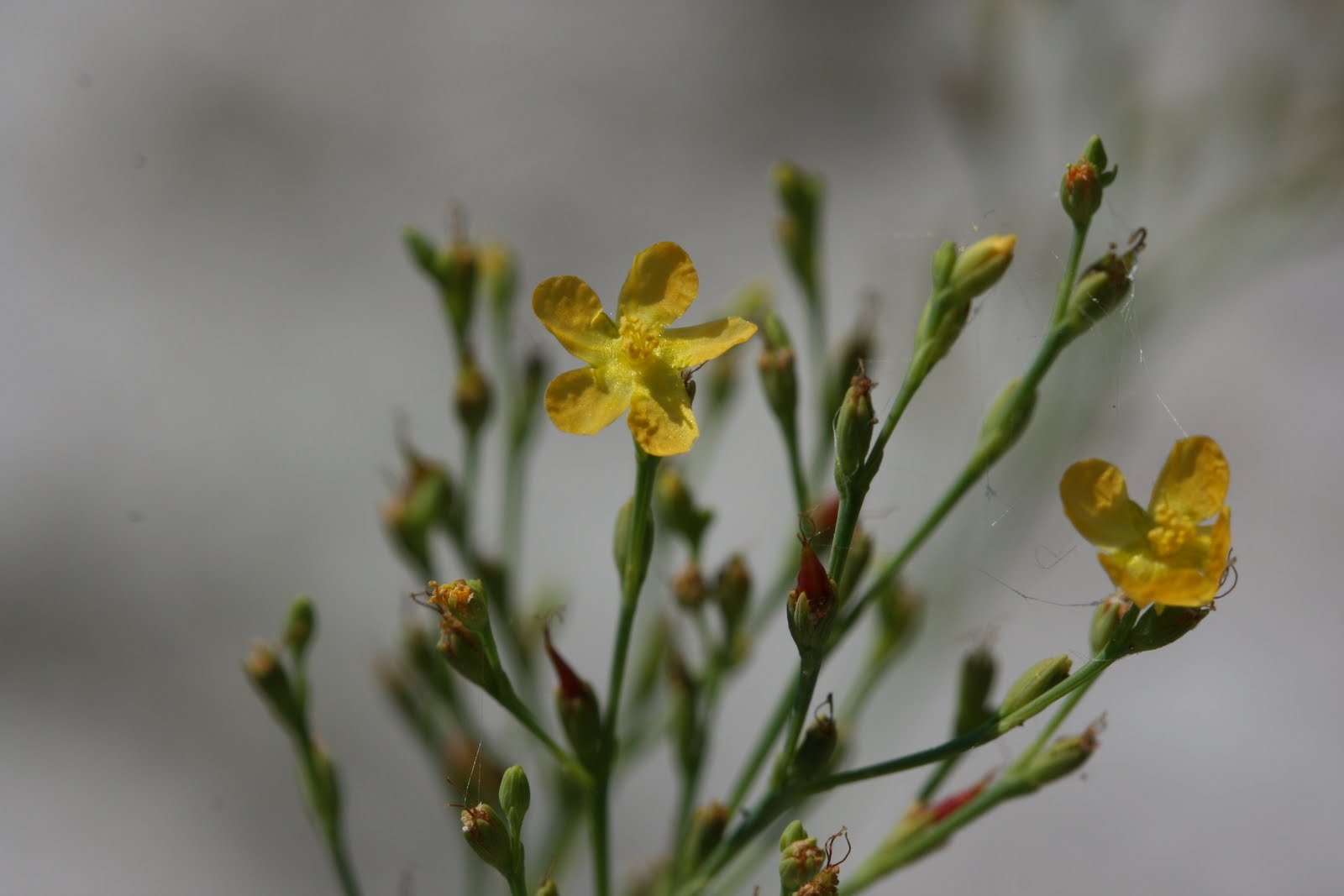
Pineweed (Hypericum gentianoides) is another small St. John's-wort. Though it sometimes stands 18 inches high, it is a wispy plant with greatly reduced foliage and flowers that rarely are as much as 1/8 inches across. Pineweed occurs in deep well-drained sands throughout most of Florida and in well-drained uplands across most of eastern North America into Ontario. It is an annual forb and relies on its abundant seed crop to persist over time.
Pineweed does not look much like a St. John's-wort when not in bloom.  The single main stem gives rise to multiple brushy stems about 6 inches above the ground and gives the plant an almost bottlebrush appearance.  The leaves are greatly reduced and scale-like. 
Flowering occurs across the tops of the multiple stems in summer.  The petals are lemon yellow in color and each flower is composed of 5 petals.  They are not arranged in a whorl as are those in Highlands scrub St. John's-wort (H. cumulicola).
I have grown this species in my home landscape, but have not had much success with keeping it long term. Because of its annual nature, it would require well-drained sandy soils with sufficient open space for its seed to germinate in each spring.  In the landscape, this species is an interesting curiosity - not especially showy even in bloom, but intriguing when planted in small clusters and mixed with other small wildflowers near the front of the planting bed.
Look closely for it when hiking in open habitats during the summer.  You may have overlooked it in the past or not realized that it is a St. John's-wort.  Recognizing it for what it is, makes it a bit more special.

Pineland St. John's-wort - Hypericum suffruticosum

Pineland St. John's-wort (Hypericum suffruticosum)  is a tiny member of this large genus and one that could be easily overlooked in the understory. It occurs in moist to average pinelands in north Florida - across the panhandle and south to about Gainesville.  It is a plant of the Southeastern Coastal Plain, and occurs elsewhere from Louisiana to North Carolina.
Pineland St. John's-wort rarely stands taller than 6 inches. The unbranched multiple stems have simple leaves that remind me of those found in most Calamintha spp. mints - oval with a decided undercurl along the margins. 
The four-petal flowers open in June and occur atop the stems; normally only one is open at one time.  These are a light lemon yellow in color with the linear petals equidistant from each other.
Because of its small size and its understated beauty, this species has not been cultivated to the best of my knowledge and is not likely to be offered in the future.  I have never attempted it myself and do not know how far its natural range might be extended in cultivation. 
Look for it if you are hiking in north Florida in early summer. Though diminutive, it is another example of Florida's fascinating flora.