Saturday, June 11, 2022

Twining Snout Bean - Rhynchosia mollissima (aka R. tomentosa var. mollissima)


There are a great many native legumes in Florida (and elsewhere) and 11 unique species in Florida.  Legumes are important nitrogen fixers in soil and a great many serve as host plants for butterflies - especially long-tailed skippers.  Twining snout bean (Rhynchosia tomentosa) is recognized as being two separate species - differing somewhat in whether they are tomentose or not.  Other taxonomists separate them as two distinct species. The photos above are var. mollissima. Both varieties (or species) share a bit of Florida in their natural ranges, but var. mollissima is most common to eastern north Florida and extends into central Florida to about the latitude of Lake and Hernando Counties.  R. tomentosa var. tomentosa is mostly limited to extreme north Florida across the Panhandle.  Their habitat preferences are the same - they occur mostly in well-drained sandy uplands; deciduous woodlands and sandhills. This species (or two species) occurs throughout much of the Southeastern Coastal Plain from extreme east Texas to the west and north to Virginia and Maryland.  

As its common name suggests, twining snout bean is a plant that twines throughout the understory though it is partly erect as the photos indicate.  It is a perennial that dies back to the ground in winter and reemerges in early spring. By late spring to early summer, it reaches its mature height (length) of about 3 feet.  Like most legumes, it has compound leaves.  These consist of 3 ovate leaflets  1-2 inches long and about 1/3 as wide.  They are opposite each other on the stem. The leaves are subtended by small stipules and a pair of amber-colored glands are present at their junction with the stem.

Flowering occurs from late May to August on a single flower stalk. A great many bright yellow flowers are clustered along the stalk and are typical legume flowers with a noticeable keel and fused lower lip. Like many legumes, they are primarily pollinated by bees.

Although snout beans have value in the landscape, I am not aware of any in this genus currently propagated commercially by members of FANN - the Florida Association of Native Nurseries.  I have not done so either and have no personal experience with them in a home landscape. They should be easily propagated from ripe seed collected from the mature beans in late summer to fall.

These photos were taken by my friend and incredible field ecologist, Alex de la Paz, and used by permission.

Wednesday, June 8, 2022

Sundial Lupine - Lupinus perennis


Unlike the rest of Florida's native lupines, sundial lupine (Lupinus perennis) is widely distributed throughout eastern North America - from Florida and extreme east Texas in the south, to Minnesota and northern Maine in the north. It is not especially common in Florida, however, as it is at the southernmost limit of its range in the Panhandle.  Unlike Florida's other lupines, it also is a long-lived perennial; our other species tend to bloom in their second and third year and then die.  Individual plants are rhizomatous so it spreads into large clumps over time. In Florida, sundial lupine occurs in the well-drained soils of sandhills and xeric open woodlands though it occurs in a wide variety of soil types north of Florida. Regardless of soil preferences, it is a plant of open sunny areas.

This species is distinct in terms of its foliage as well. Its multi-parted palmate leaves are decidedly different from the single leaves of our other native species - though other non-native lupines also share this attribute. There can be as many as 11 leaflets per leaf, but always at least 7.  This is a wildflower that dies to the ground in winter and reemerges again in very early spring.  A basal rosette of compound leaves eventually reaches a mature height of about 1 foot by March. The leaves are alternate along the stem and are slightly tomentose.

Flowers are produced from late spring into early summer on single stalks that reach 1-2 feet above the basal leaves. They are typical for the genus with a large keeled lower lip. It is the only native species in Florida with a pure pinkish blue flower, unspotted and more lavender than the blue of sky-blue lupine (L. diffusus).  These flowers are pollinated mostly by bees - especially bumblebees. The ripened seed pods mature by early fall.  Lupines are the host for the frosted elfin in north Florida and also the endangered Karner blue within its limited range outside of Florida. Lupines also can be an important browse plant for deer and other herbivores, but has some toxicity to some domestic livestock. Seeds also have some toxicity if eaten in large quantities.

Like other members of this genus, sundial lupine is extremely difficult to transplant because of its deep taproot. It can be propagated by seed, however, or by dividing clumps of their newly developing plants.  Sundial lupine is widely offered in the native nursery trade north of Florida for its many attributes including its ability to fix soil nitrogen, but I have not seen it offered in Florida by nurseries affiliated with FANN - the Florida Association of Native Nurseries.  I have never attempted it in my central Florida landscapes and have no idea how well it would adapt to landscapes south of its natural range. 

Photos with permission by Lily Byrd.

Sunday, May 22, 2022

Spiked Wild Indigo - Baptisia albescens


Thanks to Alan Weakley, I have this photo to share with you all.  Spiked wild indigo (Baptisia albescens) is another of the wonderful wild indigos native to Florida.  It is recorded from only five counties in the central Florida Panhandle, but also occurs in five states to our immediate north - Georgia, Alabama, the two Carolinas, and eastern Tennessee.  Like its close cousin, wild white indigo (B. alba), it is found in well-drained soils of woodland borders and open woods and is often found in dry woodlands, pine flatwoods, and roadsides. It is a perennial and is distinguished from its close cousin by its narrower leaflets (not shown here) and the yellowish color of its lower keeled fused petals.  The tree-parted leaflets are alternate on the stem and noticeably elliptical.

Spiked wild indigo is one of the smaller and bushier species of Baptisia and grows best in partial shade to full sun. It is known for being a tough, long-lived plant that tolerates a variety of conditions from drought, poor soil, dry soil, and erosion. It dies back to the ground each winter and reaches its mature height of about 2-4 feet by early summer.  It also has a mature width of about the same.  The flower stalks hold racemes of several dozen flowers.   These are mostly pollinated by bees.  Like other members of this genus, it serves as a host to the wild indigo duskywing skipper.

Baptisias are toxic if eaten so some care should be taken if planted in a landscape. All parts are mildly toxic and include symptoms such as nausea and diarrhea. False indigo may be propagated by cuttings or seeds. The plant has a deep taproot which makes it drought tolerant, but also difficult to transplant. The fruits are unlike other Baptisia species being cylindric, about 3 times as long as the diameter, and yellowish-brown (rather than black) when mature. It has a puffy bean pod. Fruits are ripe from July to October. 

This is a species that I have never seen propagated by nurseries affiliated with FANN - the Florida Association of Native Plant Nurseries.  It may be possible to find it from native nurseries in other states where it occurs naturally.  For now, however, it seems best to simply admire it if chanced upon in its natural range. 

Monday, May 16, 2022

Harper's Beauty - Harperocallis flava


Harper's beauty (Harperocallis flava) is rare endemic wildflower vouchered from only 3 counties in the Apalachicola National Forest region of the Florida Panhandle.  These photos come courtesy of my friend Lily Byrd and are used with permission.  It is found in open wet habitats in this region - bogs, pitcher plant wet prairies and wet savannas.  It was first described in 1965 by a graduate student at FSU, Sidney McDaniel, and placed in its own genus - a name in honor of Roland Harper and with a suffix meaning beautiful.  Harper's beauty is definitely beautiful, but easily overlooked when not in bloom.

It is an upright perennial herb that dies back to the ground in winter and reemerges in spring. It eventually reaches a mature height of 2 feet by April on thin stems with narrow leaves 4-8 inches in length.  The basal leaves superficially resemble those of an iris.  A single bright yellow flower is produced atop a thin nearly-leafless stalk by late April to May.  Each is composed of 6 petals - actually "tepals" as the 3 sepals look identical to the 3 petals.  These surround the reproductive parts - 6 stamens and 3 carpals.  The flowers are visited by a variety of pollinating insects.

Harper's beauty has never been offered for sale commercially to the best of my knowledge by any native plant nursery in Florida. Its rarity within the wetlands of Apalachicola National Forest and its strict growing requirements make a very poor choice for commercial propagation for home landscapes.  Look for it if you are visiting ANF in the late spring and appreciate it for what it is.

Apalachicola Wild Indigo - Baptisia megacarpa


Once again, thanks to my friend Lily Byrd, I have these wonderful photos to share.  Apalachicola wild indigo (Baptisia megacarpa) is a state-endangered species found only locally in six counties in the north Florida Panhandle adjacent to Georgia and Alabama. It is very rare in Georgia and a bit less so in Alabama.  Throughout this region, it is found in semi-shady to shady moist, but well-drained, deciduous woodlands.  

Apalachicola wild indigo is a perennial herbaceous plant that dies back to the ground in winter and arises from a stout/deep taproot in the spring.  It eventually reaches about 3 feet tall with multiple erect stems that form a zig-zag pattern and a spreading crown.  Like most other members of the legume family, it has compound leaves. In this species, the oval leaflets are up to 6 inches long in clusters of three and attached to the stem on short petioles.  The undersides of the leaflets are silvery.

Flowering occurs in spring - April and May in Florida.  The drooping flower clusters are up to 6 inches long and comprised of about a dozen individual flowers.  Each flower is creamy white, but with a definite yellowish cast.  This easily distinguishes it from Florida's other 2 white-flowered species.  These are pollinated, like other members of this species, by bumblebees.  Fruiting occurs later and the large inflated pods ripen several months later.

It is sometimes possible to find other species of this genus for sale in Florida by members of FANN - the Florida Association of Native Nurseries.  This species, however, has never been grown commercially to the best of my knowledge - likely because of its exacting habitat requirements.  Like so many of our native wildflowers, it is best to simply admire it in the wild if you are lucky enough to find it blooming in the spring.

Sunday, May 8, 2022

Heart-leaved Meadow Alexander - Zizia aptera


Heart-leaved meadow alexander (Zizia aptera) is a perennial wildflower recorded only from Holmes and Calhoun Counties in the Florida Panhandle though it is widespread throughout much of the eastern and upper western states of the U.S.  Throughout this region, it occurs in the semi-shaded and moist understories of deciduous woodlands. It is easily distinguished from its more-common and sometimes propagated relative (Z. aurea) by its heart-shaped basal leaves.  Both are members of the carrot family (Apiaceae) and are often reputed to be hosts for the eastern black swallowtail. Though this may be the case, neither plant is listed as such in most of the references I have.

Heart-leaved meadow alexander emerges in the early spring and reaches its mature height of 1-3 feet by April to early May.  Like other members of this genus, it produces a broad crown (2-3 inches across) of golden-yellow tiny flowers on a compound umbel.  These are aesthetically attractive, but also draw the attention of small bees, syrphid flies, and butterflies.  Small dark-brown seeds mature by summer and can be used to propagate additional plants. Like other "carrots", sow these seed just beneath the soil.

This is a rare plant in Florida and not likely to be propagated in the future by native nurseries here, though it may be possible to find seed from out-of-state sources. As its close relative, Z. aurea, is often available, it would seem best to rely on it for landscape uses. 

The photos above were taken by my friend Lily Byrd and are used with permission.

Thursday, April 7, 2022

Florida Phlox - Phlox floridana


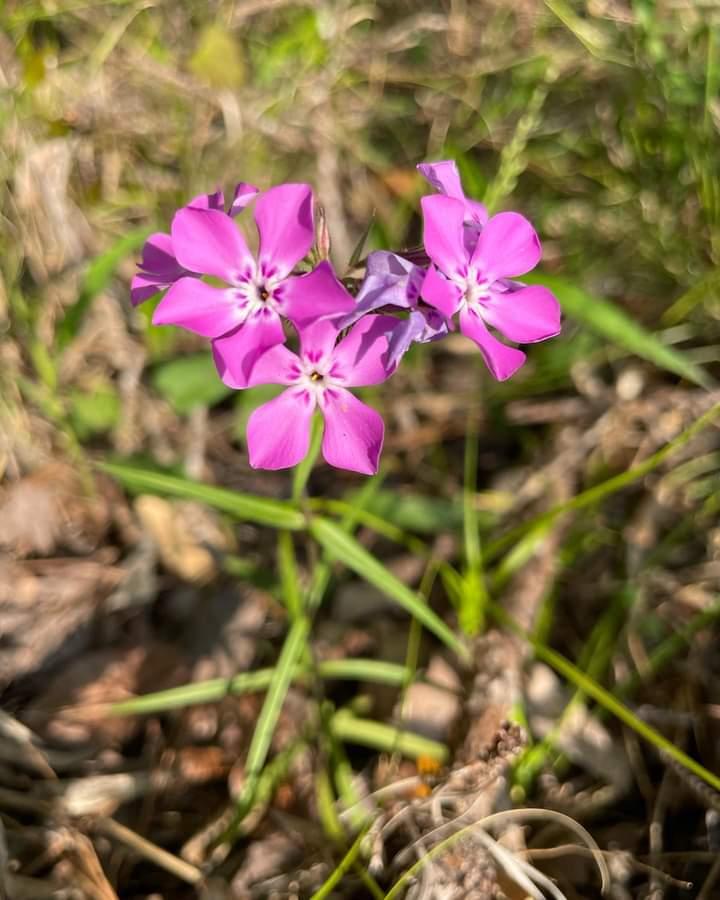
Thanks once more to my friend, Lily Byrd, I have these photos of a plant I have not previously added to add to my blog.  Florida phlox (Phlox floridana) is very similar in appearance to one I have written about previously - downy phlox (P. pilosa) and can be distinguished only by examination of the leaves just below the inflorescence.  In downy phlox, these leaves remain spreading and at right angles to the main stem while in Florida phlox they become ascending and grade into the bracts below the flowers. Otherwise, they are quite similar and are found in much the same regions of Florida.

Both species occur in open, well-drained habitats from north Florida south into north-central counties, though downy phlox is more common as you move southward. Florida phlox also has a much reduced range nationally and is a near endemic; it has been reported outside of Florida only in a few counties in extreme southern Georgia and Alabama.  

Like its close cousin, it is perennial that dies back to the ground in winter and emerges again in early spring. Individual plants eventually reach a mature height of about 12-15 inches. Flowering occurs mostly in spring, though individual blooms can occur throughout the summer. Flowers range in color from a vivid pink to paler pinks and light lavenders.  Each flower is about 3/4-inches wide.
For some reason, only woodland phlox (P. divaricata) is routinely propagated in Florida by members of FANN - the Florida Association of Native Nurseries.  This should be corrected someday as all of our perennial native species make wonderful additions to home landscapes. They add color and are of value to pollinators - especially butterflies.