Thursday, May 13, 2010

Carolina Rockrose - Crocanthemum carolinianum

Carolina rockrose (Crocanthemum carolinianum) is a rather diminutive member of this wonderful wildflower genus.  It is found throughout the northern half of Florida in well-drained sunny habitats and in the southern U.S. from Texas to North Carolina.
Unlike pinebarren frostweed (C. corymbosum) which I have also written about in this blog, Carolina frostweed remains as a short, narrow plant.  Its round basal leaves form a circle about 6 inches across.  From this, a flower stalk is produced in the early spring which eventually reaches about 12 inches in height.  Atop this stalk, several large showy yellow blooms are produced in March.  As with other members of this genus, the flowers have 5 bright yellow petals - looking very similar to those pictured for pinebarren frostweed.  I captured these photos above in early May when the seed capsules were splitting open.  Even at this stage, I find this wildflower to have a lot of charm.
Carolina frostweed is native to habitats with lots of sun and well-drained sandy soil.  If you can provide these conditions, it is easy to grow and maintain in a wildflower garden.  Mass it in the front of the bed or along trails or it will get lost amongst the other plants. 
We hope to propagate this species in the years ahead here at Hawthorn Hill to make it available to others.  Please check with us fall 2010 to see if we were successful.

Pinebarren Frostweed - Crocanthemum corymbosum

Although not as showy as some of our wildflowers, I have always admired the simple beauty of our frostweeds - or "rockroses" as I first learned them; species in the genus Crocanthemum.  Pinebarren frostweed (C. corymbosum) is perhaps my favorite.  It is found throughout Florida in upland, well-drained sandy habitats, and throughout the Southeast. 
Pinebarren  frostweed is an evergreen perennial that remains low to the ground throughout the year.  It rarely stands taller than about 8 inches, but slowly spreads outward to form a mound that can reach several feet wide.  As such, it makes an attractive mass of foliage when not blooming and always looks "tidy".  The leaves are linear, about an inch long, and alternate along the stem. 
Blooming occurs mostly in the spring, though a few flowers may be present at other times.  They are a wonderful canary yellow in color, about 1/2 inch across, with 5 petals and produced in numbers across the crown of the plant.  The contrasting orange of the anthers (the pollen-bearing parts of the flower) inside the floral "cup" lend an additional beauty to the blooms.
Pinebarren frostweed is easy to maintain in a landscape. It is extremely drought tolerant and thrives just about anywhere as long as its given good drainage and plenty of sun.  Because of its short stature, it should be placed in the front of a mixed wildflower planting or placed along trails so it can be fully admired while in bloom.  It would make a nice mass planting as well, but plant individual plants on at least 18-inch centers as they will spread outward in all directions.
Regrettably, none of the frostweeds are currently being propagated commercially in Florida - at least by nurseries associated with AFNN, the Association of Florida Native Nurseries.  We are hoping to change some of that at Hawthorn Hill.  We have maintained this species for several years now in our Pinellas County landscape and are preparing to collect seed from our plants for future propagation.  Let us know if this species interests you.  We hope to have a few seedlings by fall 2010.

Tuesday, May 11, 2010

Dwarf indigo/ Clusterspike leadplant - Amorpha herbacea

Dwarf indigo (Amorpha herbacea) is a somewhat "plain Jane" in comparison to its better known cousin, false indigo (A. fruticosa), but it has its own subtle beauty and value to a landscape composed of wildflowers.  It is rarely, if ever, propagated by commercial sources at this time, though we are correcting that at Hawthorn Hill.
I prefer to call this leadplant "sandhill leadplant" for its affinity to upland habitats.  This species occurs throughout much of Florida and in our neighboring states of the Deep South.  In extreme south Florida, it occurs as a very rare variety and component of the pine rockland community, (A. herbacea var. crenulata).  Crenulate leadplant is a state endangered species and was once afforded separate species status.  Today, taxonomists consider it to be a variety of dwarf indigo.  Throughout its range, this species occurs in droughty, well-drained soils with full sun.  It is adaptable, but will not tolerate soils that remain wet.
Dwarf indigo is deciduous and remains leafless during the winter and early spring.  The showy compound leaves are noticeably longer than in false indigo and are silvery blue-green in color; making the foliage one of the best features of this woody wildflower. 
Blooming occurs most often in early summer.  The elongated flower racemes are composed of a large number of tightly packed creamy white flowers with contrasting orange-yellow anthers.  Although these blooms are not especially showy in comparison to false indigo, they are attractive and they attract the same variety of bees, butterflies, and other pollinators.  The foliage provides the larval food for the same two butterflies; the southern dogface sulphur and silver-spotted skipper - as well as for herbivores such as rabbits and white-tailed deer.
Dwarf indigo rarely exceeds 3-4 feet tall and can be kept even shorter by regular pruning.  It tends to grow outward, however, and may form a dense crown equally wide as it is tall.  Because of its density, other plants cannot be grown beneath it.
If you have well-drained soils, plenty of sun, and the necessary space, dwarf indigo can be a very interesting addition to a landscape devoted to wildflowers and butterflies.  Use it towards the back of the garden or as a small grouping in the center to serve as a focal point.  Hawthorn Hill is currently growing this species in our Pinellas County nursery and has it available to others who may wish to try it.  Give me a call or drop me an e-mail if you are interested in this or any other wildflower curently in our catalog.

False Indigo - Amorpha fruticosa

False (or bastard) indigo (Amorpha fruticosa) is another member of the legume family that provides wonderful color as well as some value to a butterfly garden.  It is widely distributed in Florida; having been recorded in nearly every county statewide, and it occurs in nearly every state and province in North America. 
False indigo is a wetland plant in nature.  It occurs most frequently near the upper edges of riverine and other freshwater wetlands, where it receives ample soil mositure and at least a half day of sun.  It is extremely adaptable, however, and can be grown quite successfully in most upland settings except those with excessively well-drained soils.  It does well in full sun and blooms much heavier if not given too much shade.
This plant eventually gets quite large and shrublike.  It is not uncommon to find well-grown specimens that have reached 10 feet tall.  Because it also is multi-trunked, its diameter may reach 6 feet or more as well.  So, give it plenty of room if you are considering adding it to your landscape. 
False indigo is deciduous and loses its leaves from late fall until mid-spring.  The feathery compound leaves are attractive.  Shortly after they appear, large numbers of flower spikes burst forth across the tops of its many branches.  Each is a raceme 1-2 inches long, densely crowded with the showy purple flowers.  Each flower is deep purple in color with contrasting anthers that are a golden yellow.  Its this contrast that makes them especially showy.  Flowering starts at the stem end of the raceme and works its way towards the tip over about a 2 week period.
The flowers of this species are somewhat fragrant and attract a wide assortment of bees, butterflies, and other pollinators.  It also serves as the larval food plant for the southern dogface sulphur and silver-spotted skipper butterflies.  Once flowering is finished, the pollinated flowers ripen to small dry seeds that are eaten by a variety of doves and other seed-eating birds.
False indigo is available from a variety of commercial nurseries, including a few that are associated with AFNN - the Association of Florida Native Nurseries.  We have grown it for years in our landscape at Hawthorn Hill, but do not propagate it at this time.  It is very easy to grow from seed, however, and grows quickly to flowering size.
False indigo is very adaptable. Use it as a focal/anchor point in the landscape and give it some room.  Although it can be maintained as a single trunk shrub, I like it best when it is allowed to form multiple stems.  Mature specimens do not create too much shade, so many other wildflower and/or native grass species can be planted beneath it.  I like to think of this species as Florida's "butterfly bush" as it has many of the same qualities as a Buddleia, and performs much better here - at least in the southern half of the state.

Monday, May 10, 2010

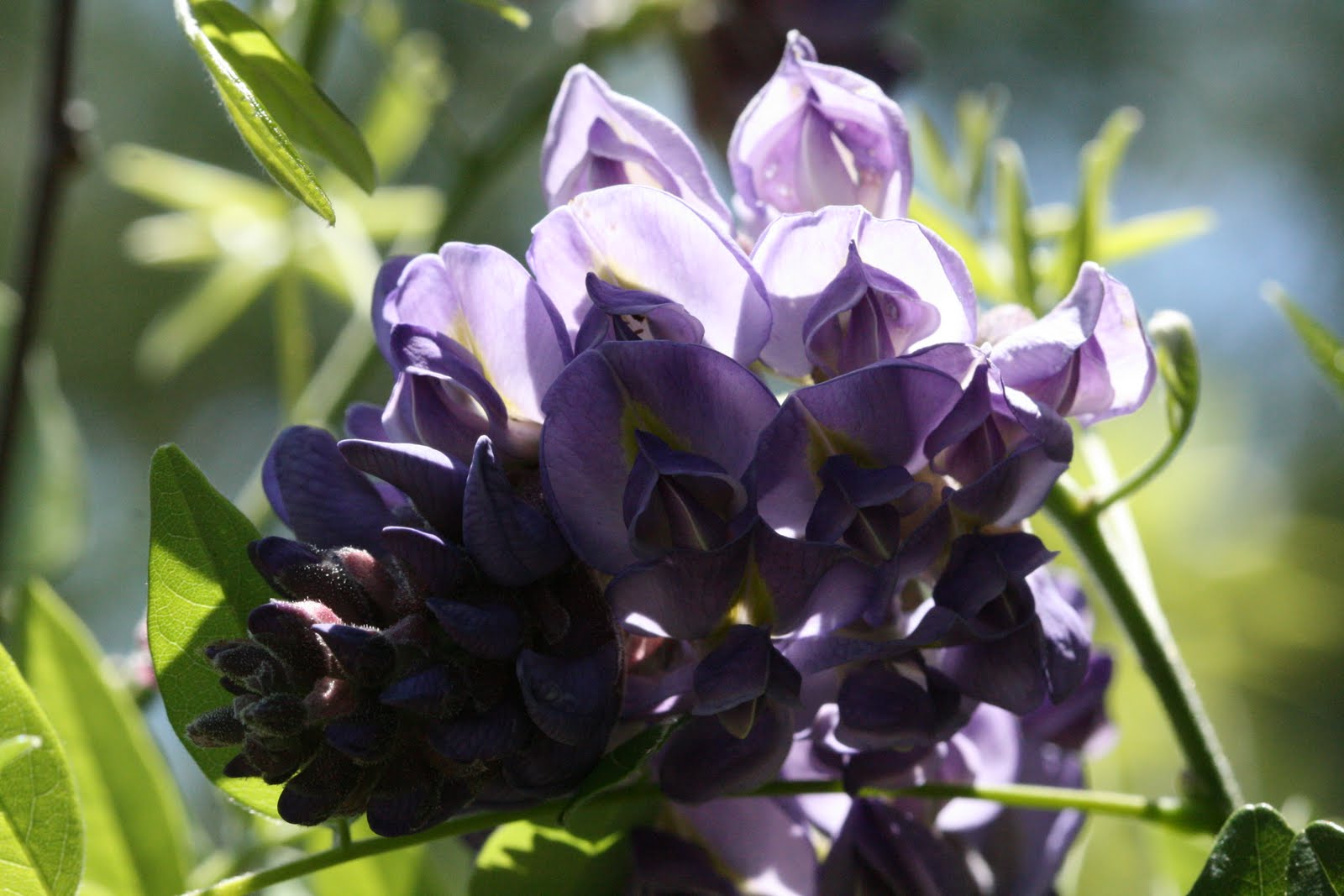
American Wisteria - Wisteria frutescens

American wisteria (Wisteria frutescens) is our only native wisteria.  The other commonly planted species all originate from Asia and can be quite invasive.  American wisteria occurs naturally in Florida only in the panhandle and a few scattered counties in north Florida.  It also occurs throughout nearly every state in the eastern half of the U.S.  Like its Asian relatives, it is a vine that rambles extensively throughout the adjacent vegetation and it can eventually extend its reach many feet from the main stem.  But, compared to Chinese and Japanese species, it is diminutive.
American wisteria is a wetland plant and most common at the edge of forested wetlands where it gets partial sun - or at least some shade for part of the day.  It is quite adaptable, however, and can be grown in the landscape in much drier soils and in nearly full sun. 
It is deciduous and remains leafless for several months during the winter.  In April to early May, the compound leaves are quickly followed by many flower buds.  These are produced on last year's growth, so it is very important not to prune these plants back in winter while they are dormant.  Each flower bud is composed of many dozens of rich purple flowers.  As this plant is in the bean and pea family (legumes), the flowers are distinctive and are followed by small heads of beans, each containing a few hard seeds.
American wisteria can be grown very effectively on a fence or trellis where its rambling growth can be somewhat maintained.  It does not have tendrils, so it may have to be helped at first while it tries to find a place to hang on to.  Give it a bit of extra water during periods of extended drought and it will perform well nearly statewide.  The plant we added to our Pinellas County landscape has bloomed profusely for years and has required very little care or attention.
American wisteria is sometimes offered by nurseries associated with AFNN - the Association of Florida Native Nurseries, though it may take some looking to find it.  We do not grow it at Hawthorn Hill, but it would be quite easy to take our seed and germinate them should an interest for it arise.  Ask us if you are interested.

Sky Blue Lupine - Lupinus diffusus

Sky blue lupine (Lupinus diffusus) is one of Florida's most beautiful wildflowers.  It is found nearly statewide in sandy well-drained uplands and in our neighboring states throughout the Deep South.  It is extremely sensitive to growing conditions and its distribution is restricted only to those areas with the proper soils and high light.  It also responds quickly to soil disturbances and prescribed fire.  Its seed can lie dormant for years waiting to be released.  When this happens, large areas can become dominated by this lupine - for a few years. 
Sky blue lupine is a very short-lived perennial.  From my experience, it rarely lives beyond about three years after germination.  The first year is spent as a non-flowering seedling while a few flowers occur in year two.  In the third year, individual plants may be several feet across and up to two feet tall.  At this size (as those plants pictured above), the entire plant seems to be covered in sky blue flowers.  Most of these plants, set large numbers of seed and then die by fall.
Sky blue lupine is unique among our native lupines.  Although most have lanceolate leaves covered by silky hairs, others tend to have pink or deep purple blooms.  The foliage is evergreen, though it often is eaten by moth caterpillars and may almost disappear for times due to this.  Flowering occurs in February through March.
As beautiful as this wildflower is, sky blue lupine is unlikely to be offered in the trade to home gardeners.  It is exceedingly difficult to grow in pots, for one.  Though I have worked with this plant for years and get most seeds to germinate, very few live past the first leaf phase.  Those that do, do not do well in pots for very long and need to be transplanted into the garden.  At this stage, most simply die as they "hate" to be moved.  But, I have had some that lived, flowered and produced seed - and these were magnificent.  If you have the right soil for lupines, and you love them as much as I do, you may wish to frustrate yourself with one of Florida's greatest wildflower gardening challenges...  If you succeed, the effort will be well worth it and if you don't, you will join countless others.  At least you will have company.

Friday, May 7, 2010

Halberdleaf Yellow Violet - Viola tripartita

Halberdleaf yellow violet (Viola tripartita; syn. V. hastata) is exceedingly rare in Florida and our most unique violet species.  In Florida it is only found in a small region around Torreya State Park in Gadsden County.  Here it grows on steep hillsides, near the base where conditions are a bit cooler and moister.  It is listed as a state endangered species.  It is more common to our north, however, and is found up the Eastern Seaboard to Maryland.
Halberdleaf yellow violet is our only yellow flowered species, though others ocur in states to our north.  Its growth form is quite distinctive.  It arises each year in late winter and has a narrow single stem which holds its "halberd-shaped" leaves several inches above the ground.  Scattered atop these plants, in late February to March are its bright yellow flowers with deep purple stripes inside the lower lip.
It is not likely that anyone will ever offer this interesting violet to the home gardener in Florida.  It is also unlikely that any of us have the conditions it needs to thrive.  For that reason, we should give thanks that wise leaders have set aside its Florida habitat in public lands - where we can search for a look at it at the right time of year.