Thursday, August 22, 2019

Carolina Goldenrod - Solidago arguta var. caroliniensis

Flowers

Flower Close Up

Stems
Goldenrods (Solidago spp.) are often difficult for the average wildflower enthusiast to identify to species. Their bright golden flowers are dead giveaways to bring you to the genus level, but after that it can get confusing. This could be the case for this one, Carolina goldenrod (S. arguta var. caroliniensis) without a close look at its foliage and the arrangement of its flowers during its summer bloom time.
Lower leaf
Two years ago, I was fortunate to purchase a couple of specimens from Marc Godts at Green Isles Nursery in the Groveland area of central Florida and these photos come from the plants I added to my wildflower garden. This species has been vouchered in most Florida counties in the northern third of the state. This variety also is widespread throughout the states of the Southeast - from Missouri and Louisiana to Maryland south along the Atlantic coast. Other varieties of this species occur as far west as Texas, through much of the Midwest and throughout the Eastern Seaboard, including populations in Quebec. Yet, despite its extensive range, very little seems to have been written about it. It is not mentioned in any of the Florida wildflower books that I own, for example.
It is reported that it occurs mostly in areas of woodland openings, such as outcrops or clearings. In my landscape, it has not been fussy about growing conditions. I have them planted in average, Florida sandy soil in full sun. It is a perennial, like other members of this genus, and dies back to the ground in winter. In spring, it forms a basal rosette of rather large oval leaves that are slightly toothed. These tend to die back, however, as the flower stalks extend in early summer. Eventually, the plants reach about 3 feet in height. The leaves and the stems are slightly "hairy" and the upper leaves along the stems become smaller and more elliptical. The ones in these photographs are about 1 inch in length. Often, the stems are somewhat reddish as well.
Flowering occurs in mid-summer, before most of the other goldenrods bloom in my landscape. A great many open panicles form at the top of the main stem and small heads of about 20 flowers occur along each side stem. This aspect, as shown in these photos above, is diagnostic for any of Florida's native goldenrods that I've encountered - or grown. The flowers are a more-lemon yellow color than most others as well.
Like other members of this genus, the blooms are especially attractive to pollinating insects. It is a wonder to me that more species are not routinely available from native nurseries here in Florida and I feel fortunate that Marc chose to propagate a few that year. Many goldenrods make poor additions to a mixed wildflower garden because they sucker extensively and I have been looking for and propagating/growing as many as I can find in order to"weed out" those aggressive species. So far, Carolina goldenrod has played well with its neighbors in my landscape. It is easy to propagate from seed and I hope to add it to the plants I offer next spring at Hawthorn Hill.

Lower Stem

Thursday, August 15, 2019

Peninsula Axilflower - Mecardonia acuminata


Peninsula axilflower (Mecardonia acuminata) is a very common wildflower in the understory of moist open habitats throughout Florida. The photos above reflect the subspecies P. acuminata subsp. peninsularis, which is a Florida endemic and found throughout much of central and south Florida. Other subspecies are found in Florida as well. Subspecies M. acuminata subsp. microphylla is a rare form vouchered only from Washington and Calhoun Counties in north Florida while subspecies M. acuminata subsp. acuminata is widespread in north-central and north Florida. The differences lie in the leaf shape and that is reflected in their various subspecies names. The species also is widespread throughout much of the eastern U.S.; its range extending from Texas to the west, north to Illinois, and east to Maryland.
This diminutive ground cover is easily overlooked by the casual hiker. It rarely stands more than 6 inches tall and grows mostly prostrate across the ground.  As such, it sends up multiple stems with dark green elliptical leaves. The subspecies photographed above, has noticeable teeth on the leaf margins. Each is about 1 inch long.  Peninsula axilflower is a perennial.
Flowering occurs from late spring to late fall.  The small tubular white flowers are produced near the tips of each stem and are horizontal to the plane of the ground below. Distinct purple lines are noticeable along the outside of the petals.  The flowers are about 1/2 inch in length.They seem to be of most interest to bees.
Peninsula axilflower, is almost ubiquitous to the edges of wet habitats in Florida, but it has never been propagated, to my knowledge, for wetland restoration projects by any of the native plant nurseries affiliated with FANN - the Florida Association of Native Nurseries. Perhaps it is simply not showy enough or too diminutive to warrant that kind of attention, but I always enjoy seeing it when hiking in its preferred habitats.

Pineland Catchfly - Polanisia tenuifolia


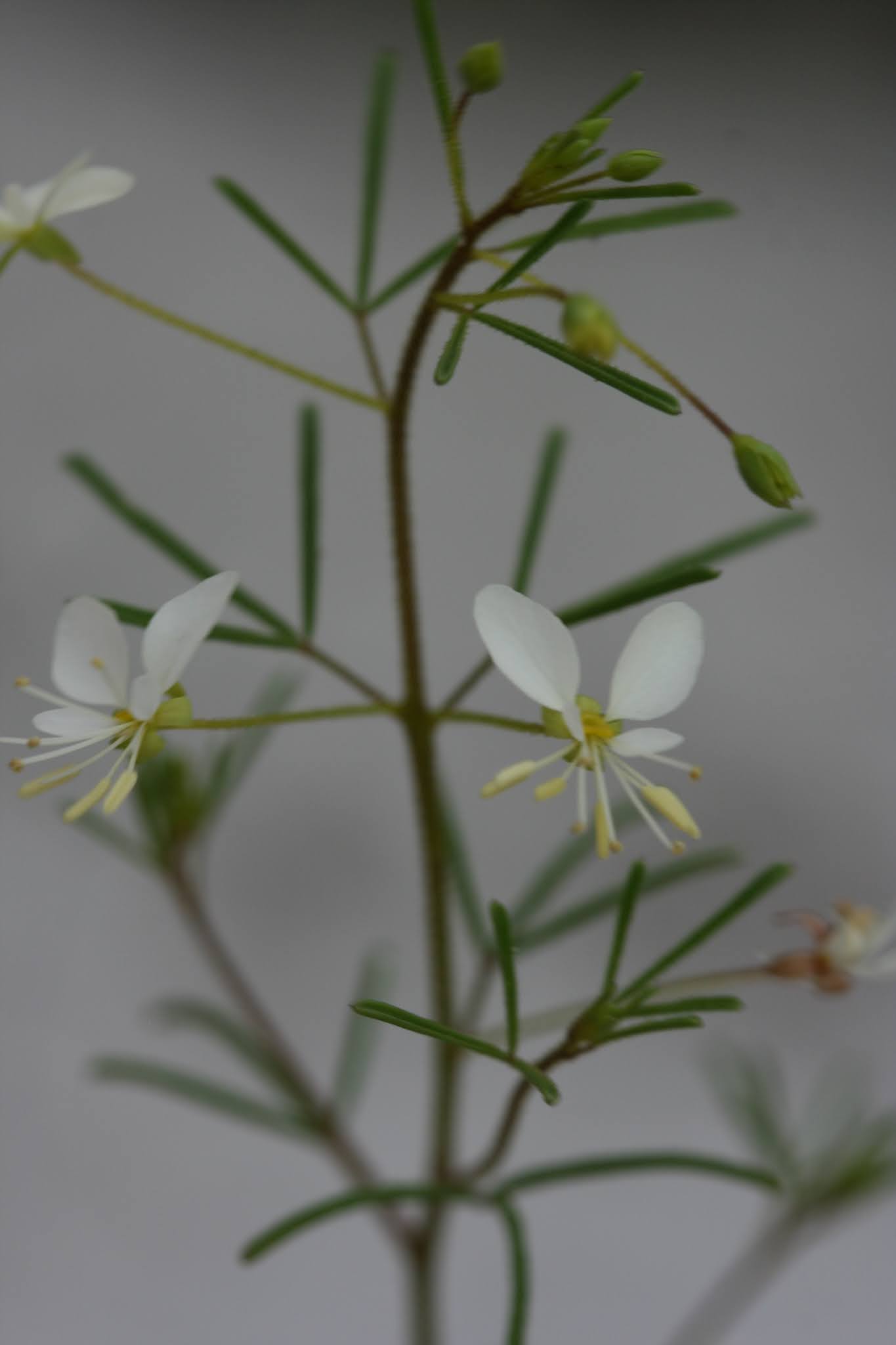
Pineland catchfly (Polanisia tenuifolia) is a common plant of central Florida sandhills and scrub, though it is found also throughout these types of upland habitats in much of north and central peninsular Florida and has been reported in Georgia, Alabama and Mississippi. It is an annual, emerging from the seedbank in early spring and maturing quickly to flowering age by late spring to late summer. 
This is a very slender plant (it's other common name, slender clammyweed, reflects this) that reaches about three feet in height. Very narrow, 3-parted leaves line the stem. They are about 1-2 inches long. The stems branch frequently and the white flowers are produced at the ends of each. Each flower is about 1/2 inch wide. The two upper petals are quite noticeable while the lower three are reduced in size. They seem to be mostly pollinated by bees.
The common name of "catchfly" is due to the fact that small insects can be trapped in the somewhat viscid secretions of the stems and leaves. It is not considered insectivorous, however, in the true sense. The purpose of this trait is not well documented and may be similar to tarflower (Bejaria racemosa) where it seems to protect the plant from small sap-sucking insects that would otherwise damage the flowers.
Pineland catchfly is an interesting species that is easily overlooked when not in bloom, but its growth habitat does not lend itself well to most landscape applications. I have never seen it offered for sale by any of the nurseries affiliated with FANN - the Florida Association of Native Nurseries or by other native nurseries in other states where it occurs. It is simply a plant to admire when hiking during the early summer in well-drained upland habitats.

Tuesday, August 13, 2019

Fall Open House - New Location in Pasco County

Wildflowers in my new landscape
Black-eyed Susan seedlings
The new nursery in my backyard
Most of you likely know that I moved last October from my former home in Seminole to a rental home in Holiday - just north of Tarpon Springs in south Pasco County. Here, I've been working diligently to set up my new landscape and nursery. Things are coming together rather well so far and I'll be ready to host my first Open House on Sunday October 13 from 9 am - 1 pm. I hope to have about 40 species of seedling wildflowers for sale at this time, as well as a few woody plants. As the date gets a bit closer, I will post a species list.
Mark your calendars if you're interested in seeing my new developing landscape and in purchasing a few hard-to-find wildflowers for your own.

You also can follow the progress of my landscape by following my new blog - werenofences.blogspot.com

 My new address is:
1648 Paragon Pl, Holiday 34690

Pineland Croton - Croton linearis

Aspect

Flowers close up

Foliage
Pineland croton (Croton linearis) is a small semi-woody shrub confined in Florida to the most-southern counties along the east coast of the state - from St. Lucie south to Miami-Dade. In this region, it occurs most frequently in pinelands. Pineland croton also occurs in the Bahamas and Greater Antilles.
Mature plants form a somewhat woody stem that can reach six feet tall, though often several feet shorter. The main stem is thin and remains flexible. It becomes a multi-stemmed plant. The leaves are alternate along the stem and decidedly elliptical. Each leaf is one inch long, sometimes as long as two inches. The underside of each leaf is covered by silvery hairs.
Flowering can occur in any month. Like other crotons, the male and female flowers are morphologically different, but on the same plant. The male flowers (the ones mostly pictured above) have longer petals and noticeable sepals below while the female flowers are smaller and without noticeable sepals. These attract small bees for the most part. Pineland croton serves as the host plant for two of South Florida's most unique butterflies - the Florida leafwing and Bartram's hairstreak. As such, it makes a very valuable addition to a butterfly garden within the geographic ranges of these two butterflies.
Pineland croton does not seem to be especially fussy in regards to its growing conditions. Although native to high pH soils. it has done very well in my landscape built on a former acidic pineland soil. It is sporadically offered for sale by native plant nurseries in extreme south Florida, but may be difficult to find without some sleuthing.  Mine came from a friend who propagated a few from plants in his yard. I do not intend to propagate seedlings from this plant in the future at Hawthorn Hill.

Saturday, August 10, 2019

Large-flowered Meadow Pink - Sabatia grandiflora

Meadow pinks (Sabatia spp.) are also called rosegentians - the problem with common names. Regardless, they comprise a large genus of native wildflowers native to wet and moist-soil habitats. Large-flowered meadow pink (S. grandiflora) is common throughout Florida at the upper edges of marshes and in moist flatwoods and prairies. It also is found in Georgia.
These are annuals. New seedlings emerge in the early spring and grow rapidly. Blooming occurs by summer and generally lasts well into fall before going to seed. As its names indicate, this species tends to be taller than most other members of this genus and the rich pink petals are often bit larger. They are generally a bit wider than 1 1/2 inches. Many members of this genus are somewhat similar in size and flower color, however, and this makes identification difficult for many in the field. To correctly identify this species, look for the upper leaves. In this species, they are thick, wrinkled and wider than the stem. The flowers are primarily pollinated by bees.
Meadow pinks make a stunning addition to many moist-soil habitats in Florida. It is nearly impossible not to encounter at least one species while in the field from summer through fall, but they are not often propagated because of the annual lifestyle. Seeds are produced in rounded capsules by fall to early winter. These can be scattered in wet meadow restoration projects and, once established, they should reseed and maintain themselves over time.

Cuban Meadowbeauty - Rhexia cubensis


Stem with Decidedly Prickles
Despite its common name Cuban meadowbeauty (Rhexia cubensis) has a rather extended range in Florida. It has been reported from nearly every county in Florida and also occurs from Louisiana to North Carolina region of the Southeastern Coastal Plain. It also occurs in parts of the Caribbean, and as its name suggests, the type specimen was first collected in Cuba.
Meadowbeauties are mostly perennials with flowers in various shades of pinks - sometimes white (there also is a yellow one in north Florida). Their urn-shaped seed capsules are the dead giveaway in getting them to genus. Getting the pink ones to species, however, requires a close look at various details of the stems and buds. Cuban meadowbeauty is often a much deeper shade of pink than the other seven mostly pink species. Each bloom is larger than most too - about 2 inches across. What is most distinctive, however, as the still hairs that occur up the stem, along the leaf margins, and on the urn-shaped ovary below the petals. These hairs are stiff and very noticeable to the touch.
This is a species of moist soils - flatwoods and prairies. It can occur in average moisture soils, but it thrives only in situations where it gets wet during the summer rainy season.
Like other members of this genus, the summer flowers have 4 large petals and an inner center of extended yellow anthers. In Cuban meadowbeauty, these anthers are greatly extended. Meadowbeauties seem of special interest to bumblebees, but other pollinating bees visit them.
This genus, though showy, is rarely propagated by nurseries not specially devoted to wetland restoration. I have found them to be difficult in mixed wildflower settings, though they spread easily in naturalized wildflower meadows that maintain adequate soil moisture. Look for this species throughout the state, but don't rely simply on the color of the petals to distinguish it. Look at (and feel) stem for the bristly hairs.