Monday, August 1, 2011

Orange Coneflower - Rudbeckia fulgida var. fulgida


Orange coneflower (Rudbeckia fulgida) is a close relative of the ubiquitous black-eyed susan (R. hirta), but is far less common here in Florida.  Whereas black-eyed susan occurs nearly statewide in Florida, orange coneflower is scattered across several central panhandle counties and south to Taylor and Dixie Counties in the "Big Bend" region of the northwestern peninsula.  Outside of Florida, this wildflower is extremely common as well.  Its geographical range extends from Texas in the west, Ontario to the north, and east at these latitudes to the Atlantic.
Throughout its range, orange coneflower is found in sunny to partly sunny locations in average uplands in average soils.  It can be found in moist sites, but is more often present in locations decidedly mesic.  In most aspects, it is similar to its close cousin, black-eyed susan - just a bit more robust.  Orange coneflower often stands 2-3 feet tall when in bloom and the flowers in Florida tend to be a bit broader. One major difference between the two is that orange coneflower is a perennial while black-eyed susan is an annual or, at best, a biennial. The other difference lies in the hairs along the main stems.  Black-eyed susan is hirsute - the hairs occur on all sides of the stem and are bristly.  The hairs on orange coneflower are strigose; mostly appressed along the stem instead of standing out in all directions.
The foliage of orange coneflower is highly variable.  In the variety found in Florida, R. fulgida var fulgida, the leaves at the upper portion of the stem are about the same size as the lower leaves.  In var. sullivantii, found in areas north of Florida, the upper leaves are noticeably reduced.
Orange coneflower is an adaptable and beautiful wildflower and should be used far more in Florida than it currently is.  Although it is widely available from native plant sources to our north, it is not currently propagated by any nursery in Florida affiliated with FANN - the Florida Association of Native Nurseries.  This is regrettable as this species is adaptable to at least the northern third of the state. I do not have experience with it outside of north Florida, though we recently acquired some specimens that we hope to evaluate.
Use this species like you would black-eyed susan.  It does best planted in mass and mixed with other medium tall wildflowers and native grasses.

Shrubby St. John's-wort - Hypericum prolificum


Shrubby St. John's-wort (Hypericum prolificum) is considered to be native to Florida, but this nativity is based on one collection made in Volusia County in 1848.  For all practical purposes, it is a species of states to our north.  Shrubby St. John's-wort occurs throughout the eastern half of the US and in Ontario. 
This is an upland species, but adapted to a wide variety of soil and light conditions.  Such adaptability has made it one of the most commonly grown species in the genus and it is offered by many native plant nurseries outside of Florida.  Named cultivars are also sometimes offered.
Shrubby St. John's-wort attains a mature height of about 3 feet.  The mounded appearance is attractive and the linear blue-green leaves and reddish stems add to its aesthetic qualities.  This is a deciduous species. The bark of mature specimens is coppery in color and peels in small sheets. 
Flowering occurs a bit later than most species; July and into August.  The flowers are a deep canary yellow and large in size.  Abundant stamens surround the carpel.  These prolific structures give it its Latin name.
I have only begun experimenting with this beautiful species in our Florida garden.  As it has not been seen in Florida for nearly 200 years, it is not propagated by any Florida native plant nursery and there is no information on its cultivation here.  Our plant originated from a North Carolina nursery.  Over the next few years, it is our intention to test its adaptability to our landscape conditions.  Perhaps we will return it as a viable landscape choice for Florida gardeners. 
Its great beauty and tolerance to a wide diversity of growing conditions in nature, make it a candidate worth investing in.

Sunday, July 3, 2011

Coyote Thistle Aster - Eurybia eryngiifolia

 
Coyote thistle aster (Eurybia eryngiifolia) occurs in the central Panhandle of Florida in open pine savannas. It also occurs in similar habitats in southern Alabama and Georgia.  In these habitats, it is adapted to moist to wet conditions during the summer rainy season and relatively dry conditions in late spring to early summer.
I have no idea where the "coyote" portion of the common name comes from.  Coyotes are relatively recent immigrants into this region of the U.S. and nothing of this plant reminds me of them...  The Latin species name comes from the appearance of the leaves which look a great deal like the common rattlesnake master (Eryngium yuccifolium). They are linear and somewhat spiny near the base.  Of course, the common name "thistle aster" refers to the same characteristic.
Coyote thistle aster is deciduous in the winter and makes an early appearance in the spring.  The whorled rosette of basal leaves is soon followed by a central flower stalk.  This reaches a mature height of 2-3 feet in summer and early fall.  The large flower buds are produced at the top of the stalk.  They are 3/4 inch across and very spiny in appearance.  Several buds are produced on each stalk.
Flowering occurs anywhere from summer to fall.  The flowers are large, quite striking and somewhat unusual.  The large central disc is a dull yellow in color and surrounded by a large number of white spidery ray flowers. Bees and butterflies are attracted to these blooms.  As the seeds ripen about a month later, the seed heads are extremely "fuzzy."
To the best of my knowledge, this distinctive wildflower has never been offered by nurseries affiliated with FANN - the Florida Association of Native Nurseries.  We have been propagating it at Hawthorn Hill (in very limited numbers) for several years, however, and hope to keep it in cultivation into the future. In our Pinellas County landscape, we grow coyote thistle aster and Chapman aster (Symphyotrichum chapmanii) in large landscape pots together with Catesby lily (Lilium catesbaei) as they all share the same basic requirements - good light, relatively fertile soil, and a bit of extra moisture.  This plant would not survive the normal conditions of my landscape, but they have done quite well in large pots where I can give them a bit better soils and moisture.
We have sold all of our "extra" plants for 2011, but hope our ripening seed crop will enable us to offer even more plants in 2012.  Ask us if interested.

Monday, June 20, 2011

Cedarglade St. John's-wort - Hypericum frondosum


Cedarglade St. John's-wort (Hypericum frondosum) is rare in Florida; confined to only two counties in the central panhandle.  Outside of Florida, it is found from Texas to New York. Throughout its range, it occurs in the edges of wetlands and in forested areas near them.
Cedarglade St. John's-wort is a large deciduous shrub.  Mature specimens can reach nearly 10 feet tall - the largest species in Florida and one of the showiest.  Unlike many other species in this genus, the bark does not peel, but occurs in platelets. It is a dull brown in color.
The foliage is elliptical and somewhat similar to that of early St. John's-wort (H. nudiflorum), but larger. The leaves also look a bit more leathery.
Flowering occurs in May.  Large buds at the tips of the many upright branches give way to extremely showy bright yellow blooms.  They have five petals and may be nearly 1 inch across.  The large mass of anthers in the center and the robust style protruding from them are quite distinctive.
This species is sometimes offered for sale outside of Florida, but has never been commercially grown here by anyone affiliated with FANN - the Florida Association of Native Nurseries, to the best of my knowledge.  We have just begun experiementing with it at Hawthorn Hill and have great expectations at this time for its eventual production. Given its attractive growth form and its spectacular flowers, it seems to have significant landscape potential.

Early St. John's-wort - Hypericum nudiflorum


Early St. John's-wort (Hypericum nudiflorum) is a wetland species that occurs in riverine floodplains and swamps in the central Panhandle region of Florida and in much of the Southeastern Coastal Plain.  It is a deciduous woody shrub and it can reach heights of nearly 6 feet at maturity.
Overall, this is an erect shrub, with a leafless main stem that is cinnamon in color and with decidedly flaky bark.  Many branches arise from the main stem, but the aspect tends to be narrow and irregular instead of rounded. The opposite leaves are elliptical, nearly 1 inch long and yellowish green in color.
The Latin name comes from the fact that the flowers seem "naked" atop the stems because the sepals are small and recurved.  The common name is also related to flowering.  Early St. John's-wort tends to bloom in early May, about a month before most other species.  The rich yellow flowers occur at the ends of each branch in clusters. Each bloom has five petals.
We have just begun experimenting with this species at Hawthorn Hill.  Our plants came from a mail order nursery near Florida and at this time I am not sure how well they will fare in west-central Florida.  There are no Florida nurseries, to my knowledge, that have ever propagated this species.
Because of its size and deciduous nature, it would seem to be best suited to the edges of ponds and other wetlands. I have no experience evaluating its drought hardiness, but in our landscape it seems to perform best in partial shade. 

Sunday, June 19, 2011

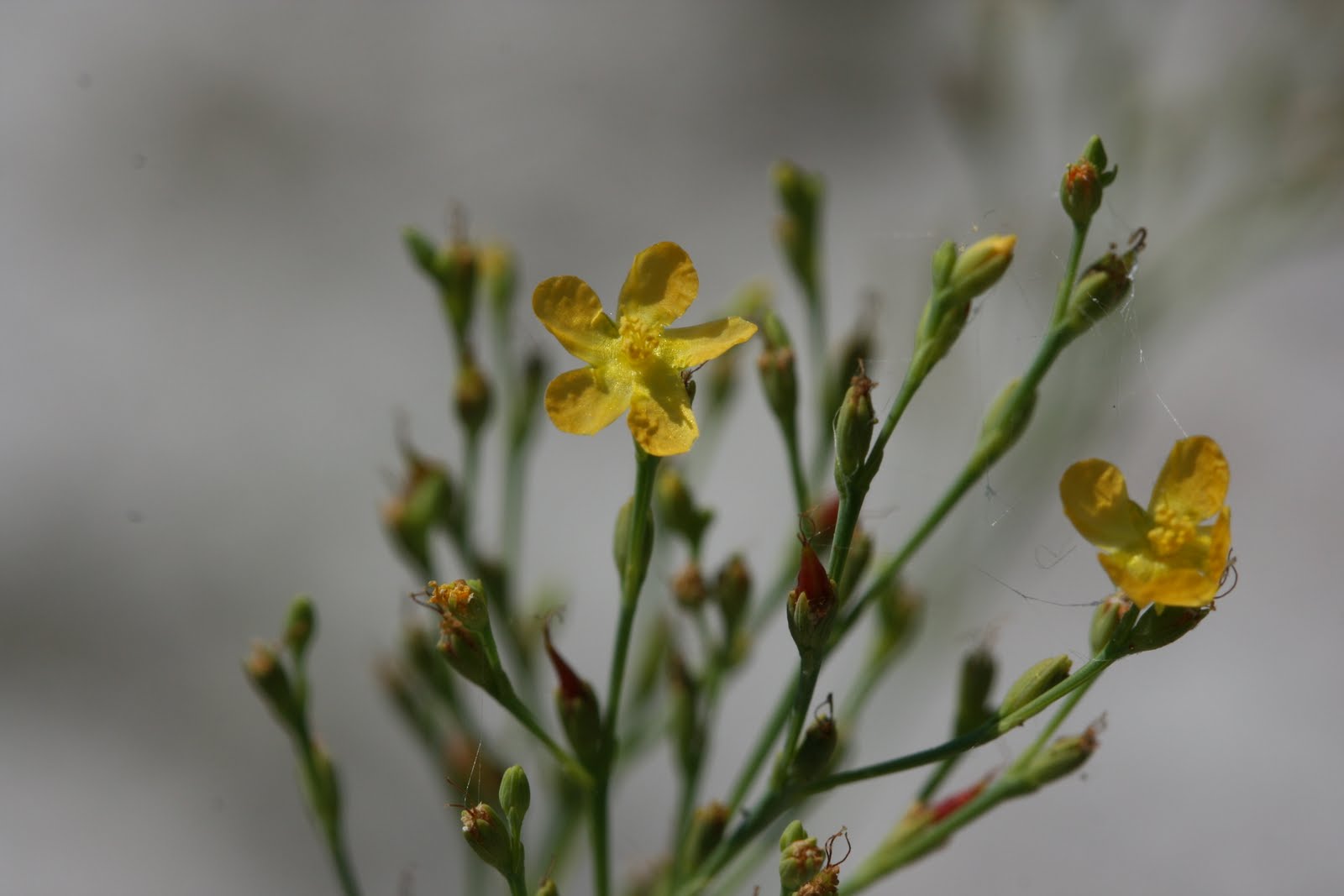
Highlands Scrub St. John's-wort - Hypericum cumulicola


Highlands scrub St. John's-wort (Hypericum cumulicola) is a state and federally listed endangered species confined to a few scrubs in Highlands and Polk counties along the Lake Wales Ridge. It is also one of our most unique St. John's-worts.
In some respects, this species shares characteristics with pineweed (H. gentianoides).  Both species are annuals or short-lived perennials and both have few basal leaves, a main stem that produces a large number of brushy side stems, and small scale-like leaves.  In Highlands scrub St. John's-wort, however, the main stem tends to be taller (up to about 28 inches) and the side branches tend to arise nearer the top of the plant instead of near the base of the stem.
Another main difference lies in the flowers. Though both species have five lemon yellow petals, those of Highlands scrub St. John's-wort are arranged as in a pinwheel. These flowers are most common in late spring and early summer.
This extremely rare plant is strictly protected and occurs in only a few of the Lake Wales Ridge scrubs currently protected in preserves.  As with other Florida scrub endemics, this species is an obvious example of what makes Florida's flora so unique and deserving of attention.

Scrub St. John's-wort - Hypericum tenuifolium (formerly H. reductum)

Scrub St. John's-wort (Hypericum tenuifolium) is a beautiful evergreen woody wildflower and perhaps the one St. John's-wort most widely grown for home landscapes in Florida.  It occurs throughout most of Florida in excessively well-drained sandy habitats - scrub and sandhill - and in similar habitats in most of the Southeastern Coastal Plain. 
Scrub St. John's-wort is an attractive foliage plant.  Mature specimens rarely stand taller than about 18 inches, but they remain round and dense.  The multiple reddish brown stems are densely covered with shiny deep-green needle-like leaves.  These are somewhat reminiscent of coastalplain St. John's-wort (H. brachyphyllum) but the leaves do not fold upwards as they do in the latter and the two species occur in very different habitat types.
Flowering can occur in most months, but is most common in late spring and early summer.  The deep yellow, five-petal flowers arise at the ends of the many stems and plants in full bloom can have more than a dozen flowers open at any one time.
Scrub St. John's-wort is widely propagated by nurseries affiliated with FANN - the Florida Association of Native Nurseries, and is normally an easy species to find and purchase.  We do not propagate it for that reason at Hawthorn Hill, but we have grown it in our landscape for many years.  This species is extremely drought tolerant, but also unforgiving of soils that remain wet for too long.  Use it in well-drained sands and give it plenty of sun.  Because of its small stature, it looks best when used in the front portion of the planting area and I like to use it in small clusters of 3-5 plants.  I have not found individual plants to be very long-lived, so plan to replace them every 3-5 years.